



Notice: Function _load_textdomain_just_in_time was called incorrectly. Translation loading for the wpso-sort-order domain was triggered too early. This is usually an indicator for some code in the plugin or theme running too early. Translations should be loaded at the init action or later. Please see Debugging in WordPress for more information. (This message was added in version 6.7.0.) in /home/democxmp/staging.democracyworks.org.za/wp-includes/functions.php on line 6131
» Policy Brief 30: IBSA-The challenge of building democracy and development
Close

Introduction

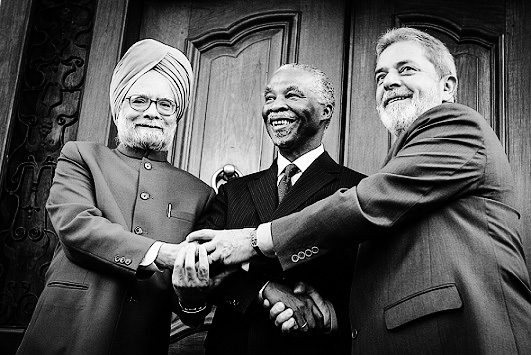
South Africa, Brazil, and India, the world’s three largest developing country democracies, have historical endowments which demand greater innovation, higher quality political leadership and better-managed institutions, to build both democracy and development.

All three countries are pursuing the twin projects of building democracy and development, unlike their allies in BRICS, China, and Russia, who are focusing on pursuing development, without democracy.

Brazil, like South Africa, was colonised by European powers as part of the New World in the 1600s. Such colonisation is of a different type to that of most African countries. Colonialism reshaped these societies and countries. Both have large white settler communities who came to hold great political, economic and social power at the end of colonialism.

Both South Africa and Brazil, before colonialism, had indigenous people populating these countries before the colonial powers introduced slaves from other parts of the world to both countries. These societies over time therefore became racially mixed, forging entirely new nations, reshaping the indigenous, settler and imported cultures into something new. Importantly, the colonial-era social hierarchy, where white skins were bestowed with social, political and economic power, persists in the post-colonial period.

Power was further dispersed based on skin pigmentation. After colonialism such colour, ethnic and religious-based inequality remains in social, political and economic spheres (Deshpande 2006 and 2012; Dutt 1976; Lloyd 2015; Seekings and Nicoli Nattrass 2005; Telles 2013; Terreblanche 2002; Wilson and Ramphele 1989).

Outside Africa, Brazil has the most people of black descent. However, black people rarely hold power in business, politics and society. The United Nations Development Programme in 2005 found there are large economic, social and power discrepancies between black and white Brazilians, with blacks remaining disadvantaged (Ciconello 2008).

“Brazilian society is effectively a two-colour one. From the point of view of privileges, access and social status, it always was. If you look at all the areas of prestige and social value in Brazilian society, it’s a two-colour system, because the whites are at the top and everyone else is at the bottom. This is no longer sustainable because those underneath are demanding change. The country will explode if you carry on maintaining these privileges for very few people in just one economic class, while the vast majority of Brazilians have no access to any of these privileged positions” (Plummer 2006).

South Africa is a mix of indigenous, imported slaves, white settler and immigrant communities from the rest of the world, which shaped the country into the world’s most diverse nation. Colonialism, slavery and apartheid entrenched a colour-based power system which has remained largely in place beyond the end of apartheid in 1994 (Seekings and Nicoli Nattrass 2005; Telles 2013; Terreblanche 2002; Wilson and Ramphele 1989).

India has its caste system it inherited from the pre-colonial era. Although legal equality exists, those from lower castes are rarely in powerful positions in politics, business, the public service, professions and civil society (Bose 2013; Dutt 1976; Chandrakanthi 2016).

Since the end of apartheid in 1994 which favoured whites, South Africa has black economic empowerment and affirmative action, which often have been used to enrich small elites, already connected to the ANC elite. India has the world’s oldest affirmative action policies. However, these have increasingly been accused of being manipulated to benefit already advantaged groups (Harris 2012; Choudhury 2015).

Brazil in 2012 introduced an affirmative law, which reserves 50% of places in public universities to low-income students. Brazil, unlike South Africa and India, has over the years focused redress policies on counteracting inequalities by expanding social welfare to the poor, who are predominantly black (Dávila 2012; Lovett and Schmidt 2017).

South Africa and India have hegemonic independence movements turned governments – the ANC and the India Congress Party. In power, the lack of democracy within these organisations was reflected in the lack of democracy in their societies also (TNN 2008; Bose; Voll 2014; Gumede 2015; Suri, Elliott and Hundt 2016). Both these organisations have been and are run by small elites – which undermine in the democracy. The Indian Congress Party in 2014 lost power to the Hindu nationalist Bharatiya Janata Party (BJP), in its worse state since it came to power in 1947 following independence.

The ANC has been in power since the end of apartheid in 1994, but lost the country’s largest cities in the 2016 local government elections, as voters desert it due to corruption, lack of delivery and indifference.

All three countries also have large areas where the official democratic institutions do not apply. In rural areas in South Africa, traditional authorities and customary law mean that women and rural dwellers are excluded from democratic rights. In Brazil, in the favelas, crime bosses rule to such an extent that constitutional rule is bypassed. In India, millions of illiterate, rural-based people, castes and tribal communities are often governed by parallel undemocratic governance systems and are cut off from democracy’s protective institutions, laws and reach (Alam 1999; Johnson 2001; Bose 2013).

Corruption of whatever form thrives on inequalities (Tanzi and Davoodi 1997; Wei 1998). Corruption undermines democracy building and economic development in all three countries. All three countries have high levels of corruption linked to high levels of inequality. In countries with inequalities, redistribution strategies are essential. However, these are also often easily corrupted (World Bank 1997).

In 2017, Transparency International, in its Corruption Perception Index (CPI), which ranked countries based on their institutional perceptions of public sector corruption, ranked India the 81st most corrupt country in the world. In 2017, Singapore and New Zealand as the least corrupt countries according to the CPI. South Africa ranked 71 and Brazil ranked 96th. In 2018, civil society opposition to, and media exposure of corruption forced the governing ANC to push then president Jacob Zuma out of the country presidency. In 2016, former Brazilian president Dilma Rousseff was impeached after senators accused her of manipulating the federal budget to finance social welfare.

Poverty, inequality and power imbalances entrenched along ethnic lines

Large sections of all three countries are poor, illiterate and socially unequally, often more pronounced among sections of the population who were at the bottom rung during colonialism. As a case in point, in Brazil, only in 1985 which at the time made up one-fourth of the country’s population, were illiterates given the vote. Massive economic, political and social inequalities across race, colour and caste make democracy building and democracy very difficult. Brazil and South Africa are the two most unequal societies in the world.

In Brazil, long periods of military rule following independence brought a particularly autocratic culture to political institutions, which has been hard to undo (Hagopian and Mainwaring 1987; UNDP 2005; Burbac, Fuentes and Fox 2013). In South Africa, although the country has adopted a new democratic constitution, established new democratic institutions and reformed old ones, the undemocratic culture of the apartheid government remains firmly entrenched in public institutions (Gumede 2005, 2009 and 2014).

India may have adopted its democratic constitution in 1950, however, aspects of autocratic colonial and pre-colonial administrative, political and social cultures still dominate many public institutions (Austin 2003; Bhargava 2010; Bose 2013).  This means that even after colonialism, apartheid or military rule, the power structures of the former autocratic regimes are still firmly in place.

An individual’s level of education in all three countries also heavily depends on one’s ethnicity, race and caste (Terreblanche 2002; Seekings and Nattrass 2005; UNDP 2005; Gang, Sen and Yun 2010; The Economist 2013, 2017; Justin Rowlatt 2015; Weinstein 2016).  Business, the media and professions in Brazil and South Africa are dominated by whites. In India, the lower castes are absent or not fairly represented in power structures of society (The Economist 2013).

The ethnic, religious and colour differences inherited from colonialism and apartheid, for all three countries in the modern era remain sources of potential divisions and conflict (Dutt 1947, 1976; Hagopian and Mainwaring 1987; Do Vale 2015; Terreblanche 2002; Seekings and Nattrass 2005; Guha (2017).

In India, religious cleavages between Muslims and Hindus, and caste differences have remained an obstacle to inclusive democracy and equitable development. In South Africa, apartheid and colonial governments deliberately segregated blacks and whites along colour lines – giving privileges based on colours, with whites the most, and decreasing the privilege the darker the colour. Such divisions have endured beyond colonialism and apartheid – with populist politicians ready to exploit these for electoral gain.

Colonial and apartheid governments internally developed South Africa, Brazil and India enclave-like. This has left regional inequalities on top of all the inequalities (Hagopian and Mainwaring 1987; Terreblanche 2002; Seekings and Nattrass 2005; UNDP 2005; Gang, Sen and Yun 2010; Do Vale 2015; Weinstein 2016). In South Africa, areas, where whites lived, were developed, while the Bantustans, where blacks lived have remained largely underdeveloped (Terreblanche 2002; Seekings and Nattrass 2005; Gumede 2014).

Similarly, in Brazil and India, some regions were more developed than others by colonial governments. In the post-colonial periods, such areas have to catch up, but remains potential political hotspots of rebellions (Johnson 2001; Bose 2010; Do Vale 2015).

The military took power in Brazil in 1964, through a coup. Until the 1980s, the military in Brazil had a veto on important legislation. A new Brazil constitution was written more democratically in 1987. Prior to democracy building in the 1980s, Brazil was left with one of the largest external debts in the world, cramping the policy space of any government (Hagopian and Mainwaring 1987).

The democratic institutions in these countries were formed by colonialism. In Brazil, post-colonial authoritarian rule, in South Africa, apartheid, and in India, the colonial and pre-colonial institutional cultures. This meant that these institutions are embedded with the authoritarian cultures of those that preceded them. Ways of doing inherited from autocratic eras, hold powerful sway in key institutions in the democratic eras.

Furthermore, in both Brazil and South Africa, key autocratic regimes actors, either joined the opposition, remained in public service or in business, continuing to assert their influence in the democratic era also (Gumede 2005; Burbac, Fuentes and Fox 2013).

The military in Brazil, after leaving power in the 1980s, even formed their own political party which commanded significant political influence for long periods. In South Africa, the National Party of apartheid was in power in a Government of National Unity (GNU) for a whole term after the end of apartheid.

In both Brazil and South Africa, military and apartheid regimes used torture, ignored human rights and manipulated intelligence and security structures to marginalise critics. Such tactics, though illegal in the new democracies, often persist, as they are deeply ingrained in the institutional cultures of the police, prosecuting and military institutions. Political parties in Brazil, which opposed the military, in South Africa, which opposed colonialism and apartheid, and India, which opposed colonialism, at times, have often embedded some of the undemocratic characteristics of the regimes they opposed for decades.

It means that even in a democracy, aspects of institutional cultures of public institutions including those of Parliament, have significant undemocratic elements. Political parties and democratic institutions have to be transformed to make them democratic, while at the same time, they must perform their democratic duties.

Elites that benefited from apartheid in South Africa, and military rule in Brazil often oppose redistribution strategies to address pass inequalities, attempts to evenly distribute political, social and economic power (Gumede 2005, 2009 and 2014; Ciconello 2008; Bose 2013; Burbac, Fuentes and Fox 2013; Bhatia 2017; Robles 2018).

Furthermore, historical financial debts inherited from colonialism and apartheid in South Africa, colonialism in India, and military rule in Brazil, reduces the funds available to pursue development or redress. Servicing debts, rising inflation and successive devaluations to make exports cheaper, forced the governments to pursue austerity programmes – which invariably undermined the poor the most, exacerbating inequalities, discrimination and exclusion. South Africa inherited large public debts inherited from the apartheid-era which constrained public budgets for reconstruction, redistribution and public services (Gumede 2005).

Growth has often gone to historically advantaged, reinforcing historical inequalities 

All three countries struggle with preventing historical racial, ethnical, gender and social inequalities reproducing themselves in the democratic period. These countries also struggle to stop age-old institutional cultures, values and practices from reinforcing racial, ethnic and gender inequalities, exclusion and discrimination.

Long periods of economic growth in Brazil, India and South Africa often also increase inequalities, as the growth benefits goes mostly to the previously advantaged – who have the social, political and skills infrastructure.

Brazil has more people of African descent than any country outside Nigeria. More than half of Brazil’s population is black or mixed race, but are under-represented in government, private sector and professions, are poorer and earn less.

In 2012, the Brazilian Senate approved a bill that reserved half the places in federal universities to students from public schools and low income families who are of African, mixed or indigenous descent (BBC News 2012). The racial quota will be discontinued in 10 years from its inception.

The Brazilian scholar Jerry Davila (2012) writes that Brazil has attempted to deal with ongoing racial exclusion by introducing both affirmative action, but also counteracting inequalities through social welfare for the excluded. Davila (2012) argues that the lesson from Brazil is that “policies that promote inclusion are insufficient without policies that reduce exclusion”.

Among Brazil’s five regions, there is a poverty divide between the South, Southeast and Central West regions, being the more developed areas, and the North and Northeast regions of less wealthy areas, perceived to be the “black” areas. In the second round of the 2014 presidential campaign Dilma Rousseff of the Partido dos Trabalhadores (PT), said following a victory there, that the Northeast region has “traditionally been undermined by an elitist vision of Brazil” (Do Vale 2015).

Inequalities across race, ethnicity, religion, and regions mean that unscrupulous politicians can mobilise ethnic, racial and regional cleavages for political gain, perpetuating political instability. Non-democratic forms of politics are appealing for many of the socially, culturally and politically excluded in all three countries.

In India, Prime Minister Narendra Modi, the leader of the governing Bhartiya Janata Party (BJP) has been accused of populism to retain support (Chandrakanthi 2016; The Economist 2017; Safi 2017). Modi’s governing Bhartiya Janata Party (BJP) has prioritised winning over lower caste communities, which make up 41% of the country’s population (Ahmad 2017; Alam 2017). Recent electoral victories of the BJP have been on the back of galvanising the historic grievances of previously discriminated groups.

More conservative Hindu-based organisations have again focused on “Hinduisation” of lower castes to bring them into the Hindu fold. For another, BJP allied organisations are also accused of casting Muslims as the “enemy” (Chandrakanthi 2016; Ahmad 2017).

India’s caste system is the world’s oldest remaining social hierarchy (Kumar 1982; Beteille 1992; Ahuja 1993). India has a social hierarchy, consisting of higher castes, lower castes, Dalits (identified as scheduled castes or formerly “Untouchables”) and Adivasis (Scheduled Tribes). Furthermore, India has large minorities, with Muslims, Sikhs, Christians, Buddhists and Zoroastrians (Parsis) classified as minorities under the country’s National Commission for Minorities Act (1992). The lower-caste categories have less power in the structures of politics, business and society.

India’s constitution have banned untouchability, calls for redress for those historically discriminated against, with the country in 1950 introducing affirmative action measures, which made this form of redistribution the oldest of its kind (Austin 2003; Bhargava 2010). In 1954, the country’s education ministry proposed 20% of all places at educational institutions be reserved for lower-caste categories, and that qualifying admission scores should be dropped by 5% (Dutt 1976; Agrawal and Aggarwal 1991).

In 1982 the country introduced new measures that reserves 15% of all jobs in the public sector and 7.5% in the educational sphere to previously discriminated groups (Agrawal and Aggarwal 1991; Beteille 1992; Ahuja 1993). A government appointed commission in 1980 proposed that quotas in the public sector and educational sphere for scheduled castes and tribes be lifted to 27%. India’s Constitutional Court in 1992 put a ceiling on affirmative action to 50%, arguing that figures above that would undermine equal access to opportunities provisions guaranteed in the constitution (Austin 2003; Bhargava 2010). Some states (provinces) have higher reservation targets than the 50%, and are currently under litigation.

Groups outside the lower castes have strenuously opposed redistribution measures (Choudhury 2015; Prabhakar 2015). In fact there have been deadly protests against redistribution policies across India. In India political parties, especially in the rural areas, have often in campaigns organised voters along caste, religious and language “vote-banks” (The Economist 2013a, b; Rowlatt 2015; Safi 2017). Some states in India have affirmative action for religious minorities. The Tamil Nadu, the south Indian state, has reserved 3.5% of electoral seats for Muslims and Christians communities. India’s state of Kerala’s Public Service Commission has 12% reservation for Muslims.

In 2011, the Indian government announced a sub-quota of 4.5% for Muslims, within the current 27% reservation quota for Other Backward Classes (OBC), arguing that Muslims who had been given affirmative action status are unable to compete with Hindus who have been assigned affirmative action status under current affirmative action regimes. However, the proposal was heavily criticised as political opportunism by the government, with Justice Rajindar Sachar, head of a special committee appointed in 2005 to investigate the plight of the Muslim minority community saying the government should rather focus on improving public service delivery for marginalised communities (Sachar Report 2006).

In 2017, India’s Supreme Court, the highest court in the country, in a split vote, banned political candidates campaigning on the basis of language, religion and caste (Safi 2017). It ruled that an election won on ethnic, religious and language basis could be considered as corrupt.

Colonial and apartheid governments through laws, divided South African blacks into different black categories, and within these categories different subgroups (Wilson and Ramphele 1989; Terreblanche 2002; Seekings and Nattrass 2005; Gumede 2014).  Rights were given to different groups based on colour, starting with whites with the most privilege to black Africans with the least rights. Lack of delivery by the post-apartheid government for ordinary blacks, continuing the privileged position of white South Africans and the rise of a small privileged black elite aligned to the ANC in the public and private sector is a ready mix for resentment by the ordinary black still mired in poverty (Terreblanche 2002; Gumede 2014).

South Africa has introduced affirmative action and black economic empowerment after 1994, giving in select sectors, slices of mainstream white-owned companies to blacks and public sector business to black companies. However, both programmes have largely been ineffective, manipulated and on occasion corrupted (Gumede 2017). Affirmative action in the state has been more effective, with the state now predominantly black.

Increasingly affirmative action in the South African public sector has often been used as patronage to appoint friends, family and political allies of top leaders in the ANC (Gumede 2014). Government contracts are also perceived to be often given to black companies aligned to senior ANC leaders or often to companies’ set-up overnight specifically to secure government contracts, but without having the necessary expertise. Similarly, at senior executive and board level in the private sector, affirmative action positions have often gone either to ANC connected or rich blacks, white women and non-South African blacks.

A number of South African politicians have exploited black anger through left populism. In South Africa, former president Jacob Zuma has used populism and ethnic mobilisation to secure power and to stay in power (Gumede 2014). When he campaigned for president of the governing ANC in 2009, Zuma’s supporters wore “100% Zulu” T-shirts, as he corralled Zulu-speakers to vote for him on the basis of common Zulu-heritage, and not only on leadership ability. Following massive allegations of corruption Zuma had claimed that his supposed fight to bring redistribution to blacks have resulted in the old white apartheid power structures and elements of the new ANC elite pushing to have him prosecuted.

The Economic Freedom Fighters (EFF) a new left populist party and breakaway from the ANC, mostly from members of the ANC Youth League and its former president Julius Malema, have based their electoral campaign on the expropriation of land, nationalisation of key companies, and the vilification of non-blacks, saying that this, on their own, will bring redress to long-suffering blacks.

Redistribution strategies in all three countries have often been abused for populism, ideological purposes and self-enrichment, which have increased opposition to such policies, led to poor thought-out policies and ultimately not only the failure of such policies, but often impoverishing the recipients further.

Patriarchal societies with high levels of violence against women

India, Brazil and South Africa are deeply patriarchal societies with high incidents of violence against women (Kumar 1982; Seekings and Nattrass 2005; Weinstein 2016; Kaur 2016; Guha 2017).

Statistics from the Brazilian Public Security Forum released in March 2018 showed there had been a 6.5% rise in the killings of women in 2017 from the year before in Brazil (Canineu 2018; Carless 2015).

A global survey of experts on women’s issues, released in June 2018, found India to be the most dangerous national sexual violence against women (Goldsmith and Beresford 2018). India has also seen a push for positive discrimination in the workplace for women. A Women’s Reservation Bill was in 2010 passed by the Rajva Sabna. The state of Gujarat is reserving 33% of all positions in the state public sector for women.

In 2017, Statistics South Africa’s 2016 Demographic and Health Survey showed that one in five South African women older than 18 has experienced physical violence (Merten 2017). All three societies have predominantly aggressive masculinity cultures, women lack social, cultural and traditional equality and women are perceived to have a lower value. Policies in all countries have failed to tackle the patriarchal nature of traditions, religion and society, dominating families, schools, higher education institutions and workplaces, which perpetuate – and will continue to do so, violence against women.

Struggling with overcoming land inequalities inherited from colonialism and apartheid 

All three countries have struggled to provide millions of landless and homeless land, while not destroying agriculture economy, which in most cases are in the hands of privileged communities (Hagopian and Mainwaring 1987; Rao 1992; UNDP 2005; Robles 2018).

In 2017, Brazilian President Michel Temer signed in reforms which will formalise state land and property occupied illegally by informal homes, business and agricultural operations (Healy 2017). The intention of the bill, originally introduced as an executive order in December 2016, is to integrate the many informal or illegal settlements into the formal supervision of the state at all levels.

Low-income groups who could not afford property in Brazilian cities have over the years established informal homes on vacant land nearby, causing the rise of slums, called favelas. The country’s 1988 Constitution recognised the property rights of favela residents, giving them title deeds (Robles 2018). However, in spite of the 1988 provisions, the bulk of informal properties remained unregistered.

The 2017 reforms subsidised the application for title deeds, waived criminal action and give multiple titles to single structures, therefore giving title to different generations living in the same structure title deeds. The new title deeds give owners officials addresses which they can use to access credit, and allows the government to get utilities fees.

In the rural areas, landless civil society organisations, specifically the Landless Rural Workers’ Movement (MST), have campaigned for giving land to the poor, by occupying underused land (Sauer and Mészáros 2017; Robless 2018). The government have procured title deeds for such occupants of underused land, organising them into farming collectives. More recently, agribusiness has opposed such forceful occupation of land, arguing it destroys the country’s burgeoning agricultural economy.

In Brazil, since the colonial period, land has been concentrated in the hands of a few landowners, mainly white Portuguese, called the latifundia system, with black slaves and indigenous communities working the land like serfs. These landowners also controlled political, social and economic power throughout Brazil’s post-colonial period.

When Brazil’s President Joao Goulart introduced land reform in 1961, he was overthrown in 1964 by the military, in combination with the landowning elite and clandestine US government support (Burbach, Fuentes and Fox 2003). For most military rule from the 1960s to the 1980s demands for land reform were violently crushed (Hagopian and Mainwaring 1987; Robles 2018).

The military rulers pushed for Brazil to develop an export agriculture industry, opening the Savanna areas for agriculture development, and marginalising peasant movements. It caused deforestation, displacement of indigenous communities and political repression. In 1984, land rights activists, social movements and the church groups formed the Landless Movement (MST). When Brazil turned democratic in 1985, 1% of farms filled up just under 50% of all farmland (Robles 2018).

Under pressure from civil society groups, Jose Sarney, took over as civilian leader in 1985 after military governments introduced land reforms. Sarney’s land reforms included introducing land redistribution policy in the democratic constitution still to be promulgated, a promise to resettle 1.4m peasants who lost their lands because of the expansion of the agricultural industry, providing cheap finance and improving land tenure rights for those who work the farms (Robles 2018). However, the programme did not reach its targets.

Big agribusiness opposed the reform plan. Furthermore, Sarney was preoccupied with saving the economy, and did not want to unnecessarily disrupt the agriculture sector, which at the time was the best performing sector (Robles 2018). In 1989, Fernando Collor de Mellor, from the National Reconstruction Party, was elected president. Collor introduced a Washington Consensus-style policy to stabilise the economy, focusing on privatisation, strengthening property rights and reducing inflation. Land reform took a backseat (Robles 2018).

Fernando Henrique Cardoso, from the Social Democratic Party won the 1994 presidential elections. Cardoso introduced social housing, health and education support for the poor, introduced a new land reform programme, a Land Bank to fund land redistribution, new support to peasant farmers and promised to increase rates of resettlement. He focused land reform on poverty reduction, pushing to bring small farmers into the market economy “by providing them with the necessary resources to enhance their productivity potential” (Robles 2018: 22).

He built agricultural villages, but which often lacked the supporting infrastructure, such as public services, housing and power. Cardoso criminalised illegal land occupation (Robles 2018: 17). Cardoso, although more successful than his predecessors, was accused of not consulting with the feisty civil organisations, and of having initiated a top-down, technocratic policy-making process (Robles 2018: 20).

Lula da Silva and the Workers Party (PT) came to power in 2003. In 2003, he introduced a National Plan for Agrarian Reform after consulting with civil society groups, which aimed to grant land titles to half a million informal settlers, finding land for 400 000 landless rural workers and funding for small family farmers (Sauer and Mészáros 2017; Robles 2018). The programme prioritised demarcating land for indigenous communities. The Lula government ended criminalising land occupation; and introduced more technical support to small farmers, cheap finance and market access support.

Lula redistributed mostly state land, which according to critics were far from infrastructure, economic centres and markets (Sauer and Mészáros 2017; Robles 2018). Some of the redistributed land was on environmentally sensitive land. Lula expanded the agribusiness sector to turn Brazil into a global exporter. Lula also focused on reducing poverty to welfare transfers, through the Bolsa Familia (Sauer and Mészáros 2017; Robles 2018). (Sauer and Mészáros 2017; Robles 2018). The Lula government support for building big agribusinesses also strengthened the power of the traditional landholders.

India’s land inequalities persists

India’s agricultural census and socio-economic caste census showed that 5% of farmers control 32% of India’s farmland (Ministry of Rural Development 2001). More than 56% of rural households do not own land. Under half of India’s population depend on agriculture for a living, with agriculture contributing 15% of the country’s GDP, according to the country’s National Sample Survey Office.

The Congress Party during the independence struggle called for a “Land to the Tiller” strategy after independence from colonialism (Dutt 1947, 1976). At independence the Indian land system saw large numbers of tenant farmers with insure tenure rights, a small number of landowners owning large tracts of land and records of land ownership were poor (Deshpande 2006).

India’s constitution gives the powers to states to come up with land reforms laws and implement land reforms (Austin 2003; Bhargava 2010). Different states implemented land reforms in their own ways.

In 1947, an Agrarian Reform Committee led by Joseph Chelladurai Kumarappa was established to look at land reform solutions. The post-independence government in the first phase of its reform, which lasted until 1972, introduced upper ceilings to land ownership, tried to increase tenancy rights, including ownership rights and pushed to end intermediaries managing land leases, tenancy and contracts on behalf of owners and tenants (Deshpande 2006). Furthermore, the Indian government pushed for fair rents to be fixed between 20% to 25% of the gross produce of the land.

From 1972 until 1985 the government pushed owners to cultivate unused land or face losing it. From 1985 to 1995 the government worked on environmental conservation and rehabilitation of land. It established a state-owned Wasteland Development Agency to manage the land rehabilitation. From 1995 onwards the government have focused on cleaning up land ownership records, revenue administration and mulling over how to improvement implementation of land reform policy which has become stuck (Deshpande 2006).

Implementing land holdings limits and strengthening tenancy rights did not achieve much success. India’s National Commission on Agriculture has cautioned against restricting land holdings to acreages which make commercial farming unproductive (NCA 1976). Nevertheless a number of “exemptions and loopholes left by individual states allowed landlords to retain control over land holdings, most infamously through benami (nameless entity) transactions, whereby village recordkeepers (patwaris) could be bribed to register holdings in the names of deceased or fictitious persons” (NCA 1976: 10).

At the bottom-end, land redistributed to the poor, has in many cases been too small to be productive. A rise of small farmers suicides in some areas have been attributed to their inability to make redistributed small land holdings economically viable (Deshpande 2006). Land redistribution in many cases has failed because political elites are also landowners and therefore have very little political will to introduce land reform.

In many cases land reform had been captured by corrupt elements, with land tribunals at the local level established to oversee land reform were often untransparent (Thimmaiah and Aziz 1983; Rao 1990; Ministry of Rural Development 2001). In some states tenant farmers have secured ownership rights. However, in almost all the Indian states there are provisions that allow landlords to move tenants when he or she wants to cultivate the land themselves (Deshpande 2006).

Land reform in South Africa has been slow, corrupted and exploited by political opportunists for private gain 

The ANC government in1994 introduced land reform, promising to by 1999, transfer 30% of white-owned agricultural land to black farmers and provide restitution, in the form of either land or cash grants in lieu of land, for black South Africans who lost their land during apartheid (RDP 1994).

South Africa’s 1913 Natives’ Land Act (Act No. 27) forcefully excluded “members of an aboriginal race or tribe of Africa” from ownership or occupation of 90% of the land (Wilson and Ramphele 1989; Terreblanche 2002; Seekings and Nicoli Nattrass 2005). In 1996, according to Statistics South Africa, 60 000 white commercial farmers owned 70% of agricultural land and leased another 19% (StatsSA 1994, 1995 and 1996).

By the end of 2012, having failed to make the 1999 deadline it set for itself, the government only transferred one third of the 30% target to transfer land to black South Africans, the target it set in 1994. The government set 2014 as the new target deadline. However, in 2013, the government pushed back the deadline to reach the 30% transfer target from 2014 to 2025 (Nkwinti 2013).

Government incompetence, ideological rigidity, and corruption have led to the slowness of the restitution programme. Many influential ANC leaders argue that just transferring land will automatically reduce poverty, with land redistribution implemented as a standalone policy, not linked to overall growth, industrialisation and development strategies (David Mayson 2003).

In some cases land were transferred to politically-connected black politicians, with very little farming inclination. Such farms often collapsed. In others, land was put under the supervision of corrupt traditional chiefs, who parcelled out land based on patronage, which often also undermined farm productivity. Where land was given to passionate ordinary black farmers, government often did not provide them with business training, funding and support, notwithstanding that modern farming is a competitive business with long lag times and massive finance needed before the first yields are produced (David Mayson 2003; Cousins 2012).

In many other cases, where land did go to legitimate black poor recipients, many sold the land soon after receiving it for desperately needed cash (David Mayson 2003; Cousins 2012). There were instances where white farmers inflated the prices to score under the government’s “willing-seller-buyer” principle of buying white-owned farms targeted for restitution – or pillaged the farms before they sell, setting up new black farmers to fail (Nkwinti 2013). South Africa’s failing land reform programme is in danger of destroying commercial agriculture, as well as not building a new class of black farmers.

All three IBSA countries have struggled to link land reform to overall growth and industrialisation strategies, land reform programmes were also not differentiated to cater for different types of landless, homeless and asset poor groups (Rao 1992). All three countries have seen land reform being exploited for opportunistic reasons by unscrupulous politicians, leading the countries to come up with policies that may have emotional and ideological appeal, but are destructive to the broader economy, exacerbating poverty and therefore render land reform worthless.

Neither countries has being able to produce competitive commercial small farmers through land reform. In short, none of the land reform initiatives in these countries have significantly reduced ethnic, caste, race or religious-based historical asset inequalities effectively.

Strengthening IBSA cooperation

The three countries must more strategically cooperate to push for a bigger say in global governance for developing countries, pushing for fair global trade, institutions and rules, but also for democratic ones. India, South Africa and Brazil must collaborate to increase the policy space for them to be able to come up with independent policies. They must cooperate to make the global political, economic and trade policies and institutions more equitable for developing countries.

The three countries could diversify their trade away from industrial countries by trading more with each other. IBSA countries could create a complementary market between the countries (Puri 2007). Such an IBSA market would be based on one country selling to another, what the other needs, and the other way around. They could import commodities they currently source from industrial countries, from each other. For another, each country could become part of the value chains of the other’s manufacturing and services production chains – where complementary.

“India and South Africa can source competitive agricultural products and ethanol, construction materials and vehicle parts from Brazil, while Brazil and South African can source competitive pharmaceuticals and IT-enabled services from India. Similarly, Brazil and India, in turn, can source competitively certain minerals and metals from South Africa” (Puri 2007: 5).

Developing countries struggle to secure technology from industrial countries. IBSA countries could collaborate on technology exchange – one country could transfer technology in which they have expertise into another that lacked it. Developmental and democracy models from industrial countries are often inappropriate for developing countries. The IBSA countries could share their unique lessons of the twin pursuit of development and democracy amidst multicultural societies, with deep poverty and inequalities.

Research and development (R&D) – crucial for the development of new technology, is often concentrated in industrial countries. The three countries should promote greater co-research, co-knowledge creation and co-ideas fostering. This means that there has to be greater collaboration between the universities and research and policy institutions of the IBSA countries. Each country can learn from what the other has done right or wrong in their land reform, affirmative action and empowerment programmes – in order to learn from each other.

The media and civil organisations in these countries must collaborate with each other to better expose corruption, hold government and business account and to share democracy, development and nation-building experiences. Greater people-to-people exchange between these countries would help foster greater cooperation on all other levels.

Selected Bibliography

Agrawal, S. P. and Aggarwal, J. C. (1991) Educational and Social Uplift of Backward Classes: At what Cost and How? : Mandal Commission and After. Concept Publishing Company, New Delhi

Irfan Ahmad (2017) “Modi’s polarising populism makes a fiction of a secular, democratic India”, The Conversation, July 12

(http://theconversation.com/modis-polarising-populism-makes-a-fiction-of-a-secular-democratic-india-80605)

Ram Ahuja (1993) Indian Social System, Jaipur, Rawat Publications

Afroz Alam (2017) “The caste politics curse that India just can’t shake off”, The Conversation, October 6

(http://theconversation.com/the-caste-politics-curse-that-india-just-cant-shake-off-84216)

Javeed Alam (1999) “What Is Happening inside Indian Democracy?”, Economic and Political Weekly, 34 (37), Sep. 11, pp, 2649-2656

Ana Cristina Alves (2013) “Brazil–Africa Technical Co-operation: Structure, Achievements and Challenges”, South African Institute for International Affairs, Policy Brief 69, August

Granville Austin (2003) Working a Democratic Constitution: A History of the Indian Experience, Oxford, Oxford University Press

Pulapre Balakrishnan (2016) “The crisis of Indian democracy”, The Hindu, July 27

(http://www.thehindu.com/opinion/lead/The-crisis-of-Indian-democracy/article14509784.ece)

Rajeev Bhargava (2010) The Promise of India’s Secular Democracy, Oxford, xford University Press

Rukmani Bhatia (2017) “Challenges New and Old Expose Cracks in India’s Democracy”, Freedom House, August 14

(https://freedomhouse.org/blog/challenges-new-and-old-expose-cracks-india-s-democracy)

Timothy Besley and Robin Burgess (2000) “Land Reform, Poverty Reduction, and Growth: Evidence from India”, The Quarterly Journal of Economics, 115 (2) (May), pp. 389-430

Rikhil R. Bhavnani and Saumitra Jha (2014) “Gandhi’s gift: Lessons for Peaceful reform from India’s struggle for democracy”, Economics of Peace and Security Journal, 14(36), pp. 76-88, March 1

BBC News (2006) “Lula under fire over land issues”, September 26

(http://news.bbc.co.uk/2/hi/americas/5313590.stm)

BBC News (2012) “Brazil approves affirmative action law for universities”, BBC News, August 8

(https://www.bbc.com/news/world-latin-america-19188610)

Andre Beteille (1992) The Backward Classes in Contemporary India, Delhi: Oxford University Press

Sumantra Bose (2013) Transforming India: Challenges to the World’s Largest Democracy. Harvard University Press

Elaine Brum (2016) “Brazil is going through an identity crisis, not just an impeachment”, The Guardian, April 18

(https://www.theguardian.com/commentisfree/2016/apr/18/brazil-impeachment-identity-crisis-dilma-rouseff-workers-party)

Roger Burbac, Federico Fuentes and Michael Fox (2013) Latin America’s turbulent transitions: The future of twenty-first century socialism. London, Zed

Maria Laura Canineu (2018) “For Brazil’s Women, Violence Begins at Home”, Human Rights Watch, January 31

(https://www.hrw.org/news/2018/01/31/brazils-women-violence-begins-hme)

Will Carless (2015) “Brazil’s shocking violence against women, in five charts”, GlobalPost, November 18

(https://www.pri.org/stories/2015-11-18/brazils-shocking-violence-against-women-five-charts)

Gurumurthy L. Chandrakanthi (2016) “Indian Democracy – Issues and Challenges”, International Journal of Innovative Research and Development, 5(8)

(http://www.ijird.com/index.php/ijird/article/view/98145/0)

Sumit Chaturvedi (2016) “Land reforms fail, 5% of India’s farmers control 32% land”, India Spend, May 4

(http://www.indiaspend.com/cover-story/land-reforms-fail-5-of-indias-farmers-control-32-land-31897)

Chandrahas Choudhury (2015) “Affirmative action for all in India”, Al Jazeera, August 29

(https://www.aljazeera.com/indepth/opinion/2015/08/affirmative-action-india-150829083614239.html)

Alexandre Ciconello (2008) “The challenge of eliminating racism in Brazil: the new institutional framework for fighting racial inequality”, Background paper to the “From Poverty to Power: How Active Citizens and Effective States Can Change the World” Report, Oxfam International, London

Bill Cousins (2012) “Land redistribution: part of a wider agrarian strategy”, Umhlaba Wethu 15, PLAAS, University of Western Cape, September 2012.

Jerry Dávila (2012) “What Brazil does right on affirmative action”, New York Times, June 19

(https://www.nytimes.com/roomfordebate/2012/03/29/brazils-racial-identity-challenge/what-brazil-does-right-on-affirmative-action)

Paulo de Andrada Baltar et al (2010) “Moving towards decent work: Labour in the Lula Government – Reflections on recent Brazilian experience”, Global Labour University Working Papers, Paper 9, May

Ashwini Deshpande (2012) “Social justice through affirmative action in India: An assessment”, In Jeannette Wicks-Lim and Robert Pollin. Capitalism on trial: Explorations in the tradition of Thomas Weisskopf, Edward Elgar Publishing, Northampton

Ashwini Deshpande (2006) “Equity and Development – Affirmative Action in India and the United States”, Background papers for the World Development Report, World Bank, Washington DC

Angela Dewan (2018) “India the most dangerous country to be a woman, US ranks 10th in survey”, CNN, June 26

(https://edition.cnn.com/2018/06/25/health/india-dangerous-country-women-survey-intl/index.html)

Gary Duffy (2009a) “Deal in Brazil fashion race row”, BBC News, Sao Paulo, May 22

(http://news.bbc.co.uk/2/mobile/americas/8063239.stm)

Gary Duffy (2009b) “University race quotas row in Brazil”, BBC News, Rio de Janeiro, November 1

(http://news.bbc.co.uk/2/mobile/americas/8285350.stm#sa-link_location=more-story-2&intlink_from_url=https%3A%2F%2Fwww.bbc.com%2Fnews%2Fworld-latin-america-19188610&intlink_ts=1529755936333&story_slot=1-sa)

Palme R. Dutt (1976) Economic history of India. New Delhi, Publications Division, Government of India

Palme R. Dutt (1947) India today. Bombay, Peoples’ Publishing House

Reese Ewing (2016) “Brazil court halts government land reform program over abuse”, Reuters, April 7


(http://www.reuters.com/article/us-brazil-corruption-landrights/brazil-court-halts-government-land-reform-program-over-abuse-idUSKCN0X42PQ)

Helder Ferreira Do Vale (2015) “Territorial Polarization in Brazil’s 2014 Presidential Elections, Regional & Federal Studies, 25(3), pp. 297-311

Antonio Claret Campos Filho (2009) “Social Protection in Brazil: Recent Achievements”, Ministry of Social Development and Fight against Hunger. Presentation panel on Global Social Protection, Economic and Financial Committee of the United Nations General Assembly, New York, November 4

France24 (2017) “The limits of affirmative action in Brazil”, France24, 26 July

Ira N. Gang, Kunal Sen and Myeong-Su Yun (2010) “Caste, Affirmative Action and Discrimination in India”, Conference Paper “Ten Years of War Against Poverty Conference Papers”

(http://catalog.ihsn.org/index.php/citations/9061)

Belinda Goldsmith and Meka Beresford (2018) “India is the world’s most dangerous place for women: poll”, Reuters, June 26

(https://globalnews.ca/news/4296949/india-sexual-violence-dangerous-women/)

Ramchandra Guha (2017) India After Gandhi: 10th Anniversary Edition. New Delhi: Picador India.

William Gumede (2015)  “Marikana: A crisis of legitimacy in the institutions that form the foundations of South Africa’s 1994 post-apartheid political settlement”, Social Dynamics 14, (2), pp.  327-343

William Gumede (2012) Restless Nation: Making Sense of Troubled Times. Cape Town, Tafelberg

William Gumede (2009) “Delivering the democratic developmental state in South Africa”, In The Politics of Service Delivery, by Anne McLennan and Barry Munslow (editors), pp. 43-98, Johannesburg,  Wits University Press

William Gumede (2005) Thabo Mbeki and the Battle for the Soul of the ANC . Cape Town, Struik Random House , 2005.

Luciana Hachmann (2014) “Pursuing a Developmental State Trade Agenda in a Neo-Liberal Context: Brazil and South Africa in Comparison”, Rainer Hampp Verlag, München, Mering

Frances Hagopian and Scott Mainwaring (1987) “Democracy in Brazil: Origins, problems, prospects”, The Helen Kellogg Institute for International Affairs, Working Paper 100, September

Gardiner Harris (2012) “With Affirmative Action, India’s Rich Gain School Slots Meant for Poor”, New York Times, October 7

(https://www.nytimes.com/2012/10/08/world/asia/indias-rich-benefit-from-schools-affirmative-action.html)

Meg Healy (2017) “Update: Brazil’s Sweeping Land Reform”, Americas Society, Council of the Americas, July 5

(https://www.as-coa.org/articles/update-brazils-sweeping-land-reform)


Craig Johnson (2001) “Local democracy, Democratic decentralization and Rural Development: Theories, Challenges and Options for Policy”, Development Policy Review, 19 (4), pp. 521-532

Ravinder Kaur (2016) (ed) Too many men, too few women: Social consequences of gender imbalance in India and China, New Delhi, Orient Blackswan

Joseph Chelladurai Kumarappa (1948) “Report of the Congress Agrarian Reforms Committee”, All India Congress Committee, Indian Congress Party, New Delhi

Marion Lloyd (2015) “A Decade of Affirmative Action in Brazil: Lessons for the Global Debate”. In Robert T. Teranishi, Loni Bordoloi Pazich, Marcelo Knobel and Walter R. Allen (eds) Mitigating Inequality: Higher Education Research, Policy and Practice in an Era of Massification and Stratification (Advances in Education in Diverse Communities: Research, Policy and Praxis, 11, pp. 169-189

Patrick Lovett and Aline Schmidt (2017) “The limits of affirmative action in Brazil”, France24, July 26

(http://www.france24.com/en/20170726-focus-brazil-limits-affirmative-action-positive-discrimination-quotas-universities-racism)

Mac Margolis (2017) “A fight over a gender-bending museum exhibit points to deepening divisions”, Bloomberg, September 14

(https://www.bloomberg.com/view/articles/2017-09-14/brazil-s-identity-politics-heat-up)

Mandal Commission (1980) “Report of the Socially Backward Classes Commission (SEBC)”, Union Government of India, New Delhi

David Mayson (2003) “Joint Ventures – Evaluating land and agrarian reform in South Africa”, An Occasional Paper Series 7, PLAAS, University of the Western Cape, 2003.

Robin Mearns (1999) “Access to land in rural India”, Policy Research Working Paper 2123. Washington, DC, World Bank.

Marianne Merten (2017) “Statistics SA: One in five SA women experience physical violence, young women hard hit by HIV/Aids”, Daily Maverick, 15 May

(https://www.dailymaverick.co.za/article/2017-05-15-statistics-sa-one-in-five-sa-women-experience-physical-violence-young-women-hard-hit-by-hivaids/#.WzOwqNIzZWk)

Ministry of Rural Development (2001) “Annual Report of the Ministry of Rural Development”, New Delhi, Government of India.

National Commission on Agriculture (NCA) (1976) “National Commission on Agriculture, Part XV, Agrarian Reforms”, New Delhi, Government of India.

Gugile Nkwinti (2013) “Building vibrant, equitable, and sustainable rural

communities”, Minister of Agriculture, Speech to the National Assembly, February 2013.

Robert Plummer (2006) “Black Brazil seeks a better future”, BBC News, September 25

(http://news.bbc.co.uk/2/hi/americas/5357842.stm#sa-link_location=more-story-4&intlink_from_url=https%3A%2F%2Fwww.bbc.com%2Fnews%2Fbusiness-23862676&intlink_ts=1529756054757&story_slot=1-sa)

 Siddharth Prabhakar (2015) “20 years after Mandal, less than 12% OBCs in central govt jobs”The Times of India, Dec 26

(http://timesofindia.indiatimes.com/articleshow/50328073.cms?utm_source=contentofinterest&utm_medium=text&utm_campaign=cppst)

Lakhsmi Puri (2007) “IBSA: An emerging trinity in the new geography of international trade”, Policy Issues in International Trade and Commodities Studies Series 35, United Nations Conference on Trade and Development (UNCTAD), New York

M. Rao (1992) “Land Reform Experiences: Perspective for Strategy and Programmes”, Economic and Political Weekly, 27 (26), Jun. 27, pp. A50-A64

Wilder Robles (2018) “Revisiting Agrarian Reform in Brazil, 1985-2016”, Journal of Developing Societies, 34(1), pp. 1-34

Justin Rowlatt (2015) “Why cast is still key in Indian politics”, BBC News, October 16

(https://www.bbc.com/news/world-asia-india-34536155)

Sacher Committee (2006) “Judge Rajinder Sachar Committee on the Status of Indian Muslims Report”, Government of India, November 30

Michael Safi (2017) “India’s top court bans religion and caste from election campaigns”, The Guardian, January 3

(https://www.theguardian.com/world/2017/jan/03/indias-top-court-bans-religion-and-caste-from-election-campaigns)

Sergio Sauer and Gerge Mesazaros (2017) “The political economy of land struggle in Brazil under Workers’ Party governments”, Journal of Agrarian Change, 17,pp.397-414

Jeremy Seekings and Nicoli Nattrass (2005) Class, Race and Inequality in South Africa . New Haven,  Yale University Press

Statistics South Africa (2017) “Demographic and Health Survey 2016”, Stats SA, Pretoria, May

Statistics South Africa (1996) “Agricultural Surveys, 1994, 1995 and 1996”, StatsSA, Pretoria, 1996

C. Suri, Carolyn Elliott and David Hundt (2016) “Democracy, Governance and Political Parties in India: An Introduction”, Studies in Indian Politics, 4(1), pp. 1–7

Vito Tanzi and Hamid Davoodi (1997) “Corruption, Public Investment and Growth”, IMF Working Paper 97/139, Washington DC, International Monetary Fund

Edward Telles (2013) “Affirmative Action in Brazil”, Lasa Forum, xliv (2), Spring

(https://www.historians.org/publications-and-directories/perspectives-on-history/september-2016/brazil-regional-inequality%E2%80%94whose-vote-counts)

Sampie Terreblanche (2002) A History of Inequality in South Africa 1652-2002. Pietermaritzburg, University of KwaZulu-Natal Pres


The Economist (2013) “Affirmative action in Brazil: Slavery’s legacy”, Sao Paulo, April 26


https://www.economist.com/americas-view/2013/04/26/slaverys-legacy


The Economist (2013) “Affirmative Action: Indian reservations”, The Economist, June 29

(https://www.economist.com/americas-view/2013/04/26/slaverys-legacy)


The Economist (2017) “Group think: India’s elections still revolve around caste”, The Economist, December 8

(https://www.economist.com/asia/2017/12/08/indias-elections-still-revolve-around-caste)

TNN (2008) “No Internal Democracy in Congress – Rahul”, Times of India, March 11

https://timesofindia.indiatimes.com/india/No-internal-democracy-in-Congress-Rahul/articleshow/2853387.cms

TNN (2007) “YSR for 4% Muslim quota”, Times of India, July 5

(https://timesofindia.indiatimes.com/city/hyderabad/YSR-for-4-Muslim-quota/articleshow/2176071.cms)

Transparency International (2018) “Corruption Perceptions Index 2017”, Surveys, TI, February 21

(https://www.transparency.org/news/feature/corruption_perceptions_index_2017)

United Nations Development Programme (UNDP) (2005) “Human Development Report 2005: International Cooperation at a Crossroads – Aid, Trade and Security in an Unequal World”, New York, UNDP

Klaus Julian Voll (2014) “The Congress party: Social democracy or family business?” Heinrich-Böll-Stiftung, March

(https://www.boell.de/en/2014/03/21/congress-party-social-democracy-or-family-business)

Shang-Jin Wei (1998) Corruption in Economic Development: Beneficial Grease, Minor Annoyance or Major Obstacle? Paper presented at the Workshop on Integrity in Governance in Asia, organized by the UNDP and Transparency International, Bangkok, 29 June-1 July.

Barbara Weinstein (2016) “History: Brazil Inequality – Whose Vote Counts?” Perspectives on History, September

Francis Wilson and Mamphele Ramphele (1989) Uprooting Poverty: The South African Experience . Cape Town, David Philip


World Bank (1997) “Helping Countries Combat Corruption: The Role of the World Bank”, Washington DC, World Bank

Xinhua (2018) “Brazil seems more violence against women in 2017: study”, Xinhuanet, March 8

(http://www.xinhuanet.com/english/2018-03/08/c_137024577.htm)


Related posts.

Working Paper 16: Strengthening citizen agency through fostering self-love to boost democracy

Strengthening citizen agency through fostering self-love to boost democracy, development and collective healing in South Africa and Africa Introduction Victims...

Working Paper 15: Strengthening Democratic Morality to Undo Moral Breakdown

South Africa's overarching societal good moral values, whether set by democracy, culture, or religion, which govern individuals' behaviour, intimate spaces,...

Policy Brief 44: Civil Society, Citizens and Consumer Activism Crucial to Increase State-Owned Company Performance

Ordinary citizens, consumers, and civil society must play more active roles as shareholders of state-owned enterprises than is currently the...

Working Paper 14: African youth participation is crucial to building democratic societies

Among the greatest causes for African youth should be to defend democracy, deepen it and continuously breathe life in it....

Policy Brief 43: Democratising the Digital Economy

Introduction Digital technology, particularly Artificial Intelligence (AI), which has now become an integral part of our lives, can reinforce racism,...

Working Paper 12: Defending the Constitution

Introduction The persistent attacks on the Constitution by populists, the incompetent and the corrupt have undermined the public legitimacy of...

Working Paper 13: The Economist of the Future

Introduction We require societies and democracies that are more sustainable, inclusive, and prosperous. Yet, we seem to be going backwards,...

Policy Brief 42: Role of Legal Civil Society Organisations in Combatting Corruption

South Africa's legal profession – both public and private, certain law firms and some judiciary members have been key enablers...

Policy Brief 41: The War Against Democracy

There is an undeclared global war – the equivalent of a Cold War, between autocratic countries and those that are...

Paper 11: Lessons from Siemens for South African companies caught up in corruption

The manner in which German engineering firm, Siemens, changed its profits-at-all-cost corporate culture, cleaned up its ethics and held employees...

Introduction

South Africa, Brazil, and India, the world’s three largest developing country democracies, have historical endowments which demand greater innovation, higher quality political leadership and better-managed institutions, to build both democracy and development.

All three countries are pursuing the twin projects of building democracy and development, unlike their allies in BRICS, China, and Russia, who are focusing on pursuing development, without democracy.

Brazil, like South Africa, was colonised by European powers as part of the New World in the 1600s. Such colonisation is of a different type to that of most African countries. Colonialism reshaped these societies and countries. Both have large white settler communities who came to hold great political, economic and social power at the end of colonialism.

Both South Africa and Brazil, before colonialism, had indigenous people populating these countries before the colonial powers introduced slaves from other parts of the world to both countries. These societies over time therefore became racially mixed, forging entirely new nations, reshaping the indigenous, settler and imported cultures into something new. Importantly, the colonial-era social hierarchy, where white skins were bestowed with social, political and economic power, persists in the post-colonial period.

Power was further dispersed based on skin pigmentation. After colonialism such colour, ethnic and religious-based inequality remains in social, political and economic spheres (Deshpande 2006 and 2012; Dutt 1976; Lloyd 2015; Seekings and Nicoli Nattrass 2005; Telles 2013; Terreblanche 2002; Wilson and Ramphele 1989).

Outside Africa, Brazil has the most people of black descent. However, black people rarely hold power in business, politics and society. The United Nations Development Programme in 2005 found there are large economic, social and power discrepancies between black and white Brazilians, with blacks remaining disadvantaged (Ciconello 2008).

“Brazilian society is effectively a two-colour one. From the point of view of privileges, access and social status, it always was. If you look at all the areas of prestige and social value in Brazilian society, it’s a two-colour system, because the whites are at the top and everyone else is at the bottom. This is no longer sustainable because those underneath are demanding change. The country will explode if you carry on maintaining these privileges for very few people in just one economic class, while the vast majority of Brazilians have no access to any of these privileged positions” (Plummer 2006).

South Africa is a mix of indigenous, imported slaves, white settler and immigrant communities from the rest of the world, which shaped the country into the world’s most diverse nation. Colonialism, slavery and apartheid entrenched a colour-based power system which has remained largely in place beyond the end of apartheid in 1994 (Seekings and Nicoli Nattrass 2005; Telles 2013; Terreblanche 2002; Wilson and Ramphele 1989).

India has its caste system it inherited from the pre-colonial era. Although legal equality exists, those from lower castes are rarely in powerful positions in politics, business, the public service, professions and civil society (Bose 2013; Dutt 1976; Chandrakanthi 2016).

Since the end of apartheid in 1994 which favoured whites, South Africa has black economic empowerment and affirmative action, which often have been used to enrich small elites, already connected to the ANC elite. India has the world’s oldest affirmative action policies. However, these have increasingly been accused of being manipulated to benefit already advantaged groups (Harris 2012; Choudhury 2015).

Brazil in 2012 introduced an affirmative law, which reserves 50% of places in public universities to low-income students. Brazil, unlike South Africa and India, has over the years focused redress policies on counteracting inequalities by expanding social welfare to the poor, who are predominantly black (Dávila 2012; Lovett and Schmidt 2017).

South Africa and India have hegemonic independence movements turned governments – the ANC and the India Congress Party. In power, the lack of democracy within these organisations was reflected in the lack of democracy in their societies also (TNN 2008; Bose; Voll 2014; Gumede 2015; Suri, Elliott and Hundt 2016). Both these organisations have been and are run by small elites – which undermine in the democracy. The Indian Congress Party in 2014 lost power to the Hindu nationalist Bharatiya Janata Party (BJP), in its worse state since it came to power in 1947 following independence.

The ANC has been in power since the end of apartheid in 1994, but lost the country’s largest cities in the 2016 local government elections, as voters desert it due to corruption, lack of delivery and indifference.

All three countries also have large areas where the official democratic institutions do not apply. In rural areas in South Africa, traditional authorities and customary law mean that women and rural dwellers are excluded from democratic rights. In Brazil, in the favelas, crime bosses rule to such an extent that constitutional rule is bypassed. In India, millions of illiterate, rural-based people, castes and tribal communities are often governed by parallel undemocratic governance systems and are cut off from democracy’s protective institutions, laws and reach (Alam 1999; Johnson 2001; Bose 2013).

Corruption of whatever form thrives on inequalities (Tanzi and Davoodi 1997; Wei 1998). Corruption undermines democracy building and economic development in all three countries. All three countries have high levels of corruption linked to high levels of inequality. In countries with inequalities, redistribution strategies are essential. However, these are also often easily corrupted (World Bank 1997).

In 2017, Transparency International, in its Corruption Perception Index (CPI), which ranked countries based on their institutional perceptions of public sector corruption, ranked India the 81st most corrupt country in the world. In 2017, Singapore and New Zealand as the least corrupt countries according to the CPI. South Africa ranked 71 and Brazil ranked 96th. In 2018, civil society opposition to, and media exposure of corruption forced the governing ANC to push then president Jacob Zuma out of the country presidency. In 2016, former Brazilian president Dilma Rousseff was impeached after senators accused her of manipulating the federal budget to finance social welfare.

Poverty, inequality and power imbalances entrenched along ethnic lines

Large sections of all three countries are poor, illiterate and socially unequally, often more pronounced among sections of the population who were at the bottom rung during colonialism. As a case in point, in Brazil, only in 1985 which at the time made up one-fourth of the country’s population, were illiterates given the vote. Massive economic, political and social inequalities across race, colour and caste make democracy building and democracy very difficult. Brazil and South Africa are the two most unequal societies in the world.

In Brazil, long periods of military rule following independence brought a particularly autocratic culture to political institutions, which has been hard to undo (Hagopian and Mainwaring 1987; UNDP 2005; Burbac, Fuentes and Fox 2013). In South Africa, although the country has adopted a new democratic constitution, established new democratic institutions and reformed old ones, the undemocratic culture of the apartheid government remains firmly entrenched in public institutions (Gumede 2005, 2009 and 2014).

India may have adopted its democratic constitution in 1950, however, aspects of autocratic colonial and pre-colonial administrative, political and social cultures still dominate many public institutions (Austin 2003; Bhargava 2010; Bose 2013).  This means that even after colonialism, apartheid or military rule, the power structures of the former autocratic regimes are still firmly in place.

An individual’s level of education in all three countries also heavily depends on one’s ethnicity, race and caste (Terreblanche 2002; Seekings and Nattrass 2005; UNDP 2005; Gang, Sen and Yun 2010; The Economist 2013, 2017; Justin Rowlatt 2015; Weinstein 2016).  Business, the media and professions in Brazil and South Africa are dominated by whites. In India, the lower castes are absent or not fairly represented in power structures of society (The Economist 2013).

The ethnic, religious and colour differences inherited from colonialism and apartheid, for all three countries in the modern era remain sources of potential divisions and conflict (Dutt 1947, 1976; Hagopian and Mainwaring 1987; Do Vale 2015; Terreblanche 2002; Seekings and Nattrass 2005; Guha (2017).

In India, religious cleavages between Muslims and Hindus, and caste differences have remained an obstacle to inclusive democracy and equitable development. In South Africa, apartheid and colonial governments deliberately segregated blacks and whites along colour lines – giving privileges based on colours, with whites the most, and decreasing the privilege the darker the colour. Such divisions have endured beyond colonialism and apartheid – with populist politicians ready to exploit these for electoral gain.

Colonial and apartheid governments internally developed South Africa, Brazil and India enclave-like. This has left regional inequalities on top of all the inequalities (Hagopian and Mainwaring 1987; Terreblanche 2002; Seekings and Nattrass 2005; UNDP 2005; Gang, Sen and Yun 2010; Do Vale 2015; Weinstein 2016). In South Africa, areas, where whites lived, were developed, while the Bantustans, where blacks lived have remained largely underdeveloped (Terreblanche 2002; Seekings and Nattrass 2005; Gumede 2014).

Similarly, in Brazil and India, some regions were more developed than others by colonial governments. In the post-colonial periods, such areas have to catch up, but remains potential political hotspots of rebellions (Johnson 2001; Bose 2010; Do Vale 2015).

The military took power in Brazil in 1964, through a coup. Until the 1980s, the military in Brazil had a veto on important legislation. A new Brazil constitution was written more democratically in 1987. Prior to democracy building in the 1980s, Brazil was left with one of the largest external debts in the world, cramping the policy space of any government (Hagopian and Mainwaring 1987).

The democratic institutions in these countries were formed by colonialism. In Brazil, post-colonial authoritarian rule, in South Africa, apartheid, and in India, the colonial and pre-colonial institutional cultures. This meant that these institutions are embedded with the authoritarian cultures of those that preceded them. Ways of doing inherited from autocratic eras, hold powerful sway in key institutions in the democratic eras.

Furthermore, in both Brazil and South Africa, key autocratic regimes actors, either joined the opposition, remained in public service or in business, continuing to assert their influence in the democratic era also (Gumede 2005; Burbac, Fuentes and Fox 2013).

The military in Brazil, after leaving power in the 1980s, even formed their own political party which commanded significant political influence for long periods. In South Africa, the National Party of apartheid was in power in a Government of National Unity (GNU) for a whole term after the end of apartheid.

In both Brazil and South Africa, military and apartheid regimes used torture, ignored human rights and manipulated intelligence and security structures to marginalise critics. Such tactics, though illegal in the new democracies, often persist, as they are deeply ingrained in the institutional cultures of the police, prosecuting and military institutions. Political parties in Brazil, which opposed the military, in South Africa, which opposed colonialism and apartheid, and India, which opposed colonialism, at times, have often embedded some of the undemocratic characteristics of the regimes they opposed for decades.

It means that even in a democracy, aspects of institutional cultures of public institutions including those of Parliament, have significant undemocratic elements. Political parties and democratic institutions have to be transformed to make them democratic, while at the same time, they must perform their democratic duties.

Elites that benefited from apartheid in South Africa, and military rule in Brazil often oppose redistribution strategies to address pass inequalities, attempts to evenly distribute political, social and economic power (Gumede 2005, 2009 and 2014; Ciconello 2008; Bose 2013; Burbac, Fuentes and Fox 2013; Bhatia 2017; Robles 2018).

Furthermore, historical financial debts inherited from colonialism and apartheid in South Africa, colonialism in India, and military rule in Brazil, reduces the funds available to pursue development or redress. Servicing debts, rising inflation and successive devaluations to make exports cheaper, forced the governments to pursue austerity programmes – which invariably undermined the poor the most, exacerbating inequalities, discrimination and exclusion. South Africa inherited large public debts inherited from the apartheid-era which constrained public budgets for reconstruction, redistribution and public services (Gumede 2005).

Growth has often gone to historically advantaged, reinforcing historical inequalities 

All three countries struggle with preventing historical racial, ethnical, gender and social inequalities reproducing themselves in the democratic period. These countries also struggle to stop age-old institutional cultures, values and practices from reinforcing racial, ethnic and gender inequalities, exclusion and discrimination.

Long periods of economic growth in Brazil, India and South Africa often also increase inequalities, as the growth benefits goes mostly to the previously advantaged – who have the social, political and skills infrastructure.

Brazil has more people of African descent than any country outside Nigeria. More than half of Brazil’s population is black or mixed race, but are under-represented in government, private sector and professions, are poorer and earn less.

In 2012, the Brazilian Senate approved a bill that reserved half the places in federal universities to students from public schools and low income families who are of African, mixed or indigenous descent (BBC News 2012). The racial quota will be discontinued in 10 years from its inception.

The Brazilian scholar Jerry Davila (2012) writes that Brazil has attempted to deal with ongoing racial exclusion by introducing both affirmative action, but also counteracting inequalities through social welfare for the excluded. Davila (2012) argues that the lesson from Brazil is that “policies that promote inclusion are insufficient without policies that reduce exclusion”.

Among Brazil’s five regions, there is a poverty divide between the South, Southeast and Central West regions, being the more developed areas, and the North and Northeast regions of less wealthy areas, perceived to be the “black” areas. In the second round of the 2014 presidential campaign Dilma Rousseff of the Partido dos Trabalhadores (PT), said following a victory there, that the Northeast region has “traditionally been undermined by an elitist vision of Brazil” (Do Vale 2015).

Inequalities across race, ethnicity, religion, and regions mean that unscrupulous politicians can mobilise ethnic, racial and regional cleavages for political gain, perpetuating political instability. Non-democratic forms of politics are appealing for many of the socially, culturally and politically excluded in all three countries.

In India, Prime Minister Narendra Modi, the leader of the governing Bhartiya Janata Party (BJP) has been accused of populism to retain support (Chandrakanthi 2016; The Economist 2017; Safi 2017). Modi’s governing Bhartiya Janata Party (BJP) has prioritised winning over lower caste communities, which make up 41% of the country’s population (Ahmad 2017; Alam 2017). Recent electoral victories of the BJP have been on the back of galvanising the historic grievances of previously discriminated groups.

More conservative Hindu-based organisations have again focused on “Hinduisation” of lower castes to bring them into the Hindu fold. For another, BJP allied organisations are also accused of casting Muslims as the “enemy” (Chandrakanthi 2016; Ahmad 2017).

India’s caste system is the world’s oldest remaining social hierarchy (Kumar 1982; Beteille 1992; Ahuja 1993). India has a social hierarchy, consisting of higher castes, lower castes, Dalits (identified as scheduled castes or formerly “Untouchables”) and Adivasis (Scheduled Tribes). Furthermore, India has large minorities, with Muslims, Sikhs, Christians, Buddhists and Zoroastrians (Parsis) classified as minorities under the country’s National Commission for Minorities Act (1992). The lower-caste categories have less power in the structures of politics, business and society.

India’s constitution have banned untouchability, calls for redress for those historically discriminated against, with the country in 1950 introducing affirmative action measures, which made this form of redistribution the oldest of its kind (Austin 2003; Bhargava 2010). In 1954, the country’s education ministry proposed 20% of all places at educational institutions be reserved for lower-caste categories, and that qualifying admission scores should be dropped by 5% (Dutt 1976; Agrawal and Aggarwal 1991).

In 1982 the country introduced new measures that reserves 15% of all jobs in the public sector and 7.5% in the educational sphere to previously discriminated groups (Agrawal and Aggarwal 1991; Beteille 1992; Ahuja 1993). A government appointed commission in 1980 proposed that quotas in the public sector and educational sphere for scheduled castes and tribes be lifted to 27%. India’s Constitutional Court in 1992 put a ceiling on affirmative action to 50%, arguing that figures above that would undermine equal access to opportunities provisions guaranteed in the constitution (Austin 2003; Bhargava 2010). Some states (provinces) have higher reservation targets than the 50%, and are currently under litigation.

Groups outside the lower castes have strenuously opposed redistribution measures (Choudhury 2015; Prabhakar 2015). In fact there have been deadly protests against redistribution policies across India. In India political parties, especially in the rural areas, have often in campaigns organised voters along caste, religious and language “vote-banks” (The Economist 2013a, b; Rowlatt 2015; Safi 2017). Some states in India have affirmative action for religious minorities. The Tamil Nadu, the south Indian state, has reserved 3.5% of electoral seats for Muslims and Christians communities. India’s state of Kerala’s Public Service Commission has 12% reservation for Muslims.

In 2011, the Indian government announced a sub-quota of 4.5% for Muslims, within the current 27% reservation quota for Other Backward Classes (OBC), arguing that Muslims who had been given affirmative action status are unable to compete with Hindus who have been assigned affirmative action status under current affirmative action regimes. However, the proposal was heavily criticised as political opportunism by the government, with Justice Rajindar Sachar, head of a special committee appointed in 2005 to investigate the plight of the Muslim minority community saying the government should rather focus on improving public service delivery for marginalised communities (Sachar Report 2006).

In 2017, India’s Supreme Court, the highest court in the country, in a split vote, banned political candidates campaigning on the basis of language, religion and caste (Safi 2017). It ruled that an election won on ethnic, religious and language basis could be considered as corrupt.

Colonial and apartheid governments through laws, divided South African blacks into different black categories, and within these categories different subgroups (Wilson and Ramphele 1989; Terreblanche 2002; Seekings and Nattrass 2005; Gumede 2014).  Rights were given to different groups based on colour, starting with whites with the most privilege to black Africans with the least rights. Lack of delivery by the post-apartheid government for ordinary blacks, continuing the privileged position of white South Africans and the rise of a small privileged black elite aligned to the ANC in the public and private sector is a ready mix for resentment by the ordinary black still mired in poverty (Terreblanche 2002; Gumede 2014).

South Africa has introduced affirmative action and black economic empowerment after 1994, giving in select sectors, slices of mainstream white-owned companies to blacks and public sector business to black companies. However, both programmes have largely been ineffective, manipulated and on occasion corrupted (Gumede 2017). Affirmative action in the state has been more effective, with the state now predominantly black.

Increasingly affirmative action in the South African public sector has often been used as patronage to appoint friends, family and political allies of top leaders in the ANC (Gumede 2014). Government contracts are also perceived to be often given to black companies aligned to senior ANC leaders or often to companies’ set-up overnight specifically to secure government contracts, but without having the necessary expertise. Similarly, at senior executive and board level in the private sector, affirmative action positions have often gone either to ANC connected or rich blacks, white women and non-South African blacks.

A number of South African politicians have exploited black anger through left populism. In South Africa, former president Jacob Zuma has used populism and ethnic mobilisation to secure power and to stay in power (Gumede 2014). When he campaigned for president of the governing ANC in 2009, Zuma’s supporters wore “100% Zulu” T-shirts, as he corralled Zulu-speakers to vote for him on the basis of common Zulu-heritage, and not only on leadership ability. Following massive allegations of corruption Zuma had claimed that his supposed fight to bring redistribution to blacks have resulted in the old white apartheid power structures and elements of the new ANC elite pushing to have him prosecuted.

The Economic Freedom Fighters (EFF) a new left populist party and breakaway from the ANC, mostly from members of the ANC Youth League and its former president Julius Malema, have based their electoral campaign on the expropriation of land, nationalisation of key companies, and the vilification of non-blacks, saying that this, on their own, will bring redress to long-suffering blacks.

Redistribution strategies in all three countries have often been abused for populism, ideological purposes and self-enrichment, which have increased opposition to such policies, led to poor thought-out policies and ultimately not only the failure of such policies, but often impoverishing the recipients further.

Patriarchal societies with high levels of violence against women

India, Brazil and South Africa are deeply patriarchal societies with high incidents of violence against women (Kumar 1982; Seekings and Nattrass 2005; Weinstein 2016; Kaur 2016; Guha 2017).

Statistics from the Brazilian Public Security Forum released in March 2018 showed there had been a 6.5% rise in the killings of women in 2017 from the year before in Brazil (Canineu 2018; Carless 2015).

A global survey of experts on women’s issues, released in June 2018, found India to be the most dangerous national sexual violence against women (Goldsmith and Beresford 2018). India has also seen a push for positive discrimination in the workplace for women. A Women’s Reservation Bill was in 2010 passed by the Rajva Sabna. The state of Gujarat is reserving 33% of all positions in the state public sector for women.

In 2017, Statistics South Africa’s 2016 Demographic and Health Survey showed that one in five South African women older than 18 has experienced physical violence (Merten 2017). All three societies have predominantly aggressive masculinity cultures, women lack social, cultural and traditional equality and women are perceived to have a lower value. Policies in all countries have failed to tackle the patriarchal nature of traditions, religion and society, dominating families, schools, higher education institutions and workplaces, which perpetuate – and will continue to do so, violence against women.

Struggling with overcoming land inequalities inherited from colonialism and apartheid 

All three countries have struggled to provide millions of landless and homeless land, while not destroying agriculture economy, which in most cases are in the hands of privileged communities (Hagopian and Mainwaring 1987; Rao 1992; UNDP 2005; Robles 2018).

In 2017, Brazilian President Michel Temer signed in reforms which will formalise state land and property occupied illegally by informal homes, business and agricultural operations (Healy 2017). The intention of the bill, originally introduced as an executive order in December 2016, is to integrate the many informal or illegal settlements into the formal supervision of the state at all levels.

Low-income groups who could not afford property in Brazilian cities have over the years established informal homes on vacant land nearby, causing the rise of slums, called favelas. The country’s 1988 Constitution recognised the property rights of favela residents, giving them title deeds (Robles 2018). However, in spite of the 1988 provisions, the bulk of informal properties remained unregistered.

The 2017 reforms subsidised the application for title deeds, waived criminal action and give multiple titles to single structures, therefore giving title to different generations living in the same structure title deeds. The new title deeds give owners officials addresses which they can use to access credit, and allows the government to get utilities fees.

In the rural areas, landless civil society organisations, specifically the Landless Rural Workers’ Movement (MST), have campaigned for giving land to the poor, by occupying underused land (Sauer and Mészáros 2017; Robless 2018). The government have procured title deeds for such occupants of underused land, organising them into farming collectives. More recently, agribusiness has opposed such forceful occupation of land, arguing it destroys the country’s burgeoning agricultural economy.

In Brazil, since the colonial period, land has been concentrated in the hands of a few landowners, mainly white Portuguese, called the latifundia system, with black slaves and indigenous communities working the land like serfs. These landowners also controlled political, social and economic power throughout Brazil’s post-colonial period.

When Brazil’s President Joao Goulart introduced land reform in 1961, he was overthrown in 1964 by the military, in combination with the landowning elite and clandestine US government support (Burbach, Fuentes and Fox 2003). For most military rule from the 1960s to the 1980s demands for land reform were violently crushed (Hagopian and Mainwaring 1987; Robles 2018).

The military rulers pushed for Brazil to develop an export agriculture industry, opening the Savanna areas for agriculture development, and marginalising peasant movements. It caused deforestation, displacement of indigenous communities and political repression. In 1984, land rights activists, social movements and the church groups formed the Landless Movement (MST). When Brazil turned democratic in 1985, 1% of farms filled up just under 50% of all farmland (Robles 2018).

Under pressure from civil society groups, Jose Sarney, took over as civilian leader in 1985 after military governments introduced land reforms. Sarney’s land reforms included introducing land redistribution policy in the democratic constitution still to be promulgated, a promise to resettle 1.4m peasants who lost their lands because of the expansion of the agricultural industry, providing cheap finance and improving land tenure rights for those who work the farms (Robles 2018). However, the programme did not reach its targets.

Big agribusiness opposed the reform plan. Furthermore, Sarney was preoccupied with saving the economy, and did not want to unnecessarily disrupt the agriculture sector, which at the time was the best performing sector (Robles 2018). In 1989, Fernando Collor de Mellor, from the National Reconstruction Party, was elected president. Collor introduced a Washington Consensus-style policy to stabilise the economy, focusing on privatisation, strengthening property rights and reducing inflation. Land reform took a backseat (Robles 2018).

Fernando Henrique Cardoso, from the Social Democratic Party won the 1994 presidential elections. Cardoso introduced social housing, health and education support for the poor, introduced a new land reform programme, a Land Bank to fund land redistribution, new support to peasant farmers and promised to increase rates of resettlement. He focused land reform on poverty reduction, pushing to bring small farmers into the market economy “by providing them with the necessary resources to enhance their productivity potential” (Robles 2018: 22).

He built agricultural villages, but which often lacked the supporting infrastructure, such as public services, housing and power. Cardoso criminalised illegal land occupation (Robles 2018: 17). Cardoso, although more successful than his predecessors, was accused of not consulting with the feisty civil organisations, and of having initiated a top-down, technocratic policy-making process (Robles 2018: 20).

Lula da Silva and the Workers Party (PT) came to power in 2003. In 2003, he introduced a National Plan for Agrarian Reform after consulting with civil society groups, which aimed to grant land titles to half a million informal settlers, finding land for 400 000 landless rural workers and funding for small family farmers (Sauer and Mészáros 2017; Robles 2018). The programme prioritised demarcating land for indigenous communities. The Lula government ended criminalising land occupation; and introduced more technical support to small farmers, cheap finance and market access support.

Lula redistributed mostly state land, which according to critics were far from infrastructure, economic centres and markets (Sauer and Mészáros 2017; Robles 2018). Some of the redistributed land was on environmentally sensitive land. Lula expanded the agribusiness sector to turn Brazil into a global exporter. Lula also focused on reducing poverty to welfare transfers, through the Bolsa Familia (Sauer and Mészáros 2017; Robles 2018). (Sauer and Mészáros 2017; Robles 2018). The Lula government support for building big agribusinesses also strengthened the power of the traditional landholders.

India’s land inequalities persists

India’s agricultural census and socio-economic caste census showed that 5% of farmers control 32% of India’s farmland (Ministry of Rural Development 2001). More than 56% of rural households do not own land. Under half of India’s population depend on agriculture for a living, with agriculture contributing 15% of the country’s GDP, according to the country’s National Sample Survey Office.

The Congress Party during the independence struggle called for a “Land to the Tiller” strategy after independence from colonialism (Dutt 1947, 1976). At independence the Indian land system saw large numbers of tenant farmers with insure tenure rights, a small number of landowners owning large tracts of land and records of land ownership were poor (Deshpande 2006).

India’s constitution gives the powers to states to come up with land reforms laws and implement land reforms (Austin 2003; Bhargava 2010). Different states implemented land reforms in their own ways.

In 1947, an Agrarian Reform Committee led by Joseph Chelladurai Kumarappa was established to look at land reform solutions. The post-independence government in the first phase of its reform, which lasted until 1972, introduced upper ceilings to land ownership, tried to increase tenancy rights, including ownership rights and pushed to end intermediaries managing land leases, tenancy and contracts on behalf of owners and tenants (Deshpande 2006). Furthermore, the Indian government pushed for fair rents to be fixed between 20% to 25% of the gross produce of the land.

From 1972 until 1985 the government pushed owners to cultivate unused land or face losing it. From 1985 to 1995 the government worked on environmental conservation and rehabilitation of land. It established a state-owned Wasteland Development Agency to manage the land rehabilitation. From 1995 onwards the government have focused on cleaning up land ownership records, revenue administration and mulling over how to improvement implementation of land reform policy which has become stuck (Deshpande 2006).

Implementing land holdings limits and strengthening tenancy rights did not achieve much success. India’s National Commission on Agriculture has cautioned against restricting land holdings to acreages which make commercial farming unproductive (NCA 1976). Nevertheless a number of “exemptions and loopholes left by individual states allowed landlords to retain control over land holdings, most infamously through benami (nameless entity) transactions, whereby village recordkeepers (patwaris) could be bribed to register holdings in the names of deceased or fictitious persons” (NCA 1976: 10).

At the bottom-end, land redistributed to the poor, has in many cases been too small to be productive. A rise of small farmers suicides in some areas have been attributed to their inability to make redistributed small land holdings economically viable (Deshpande 2006). Land redistribution in many cases has failed because political elites are also landowners and therefore have very little political will to introduce land reform.

In many cases land reform had been captured by corrupt elements, with land tribunals at the local level established to oversee land reform were often untransparent (Thimmaiah and Aziz 1983; Rao 1990; Ministry of Rural Development 2001). In some states tenant farmers have secured ownership rights. However, in almost all the Indian states there are provisions that allow landlords to move tenants when he or she wants to cultivate the land themselves (Deshpande 2006).

Land reform in South Africa has been slow, corrupted and exploited by political opportunists for private gain 

The ANC government in1994 introduced land reform, promising to by 1999, transfer 30% of white-owned agricultural land to black farmers and provide restitution, in the form of either land or cash grants in lieu of land, for black South Africans who lost their land during apartheid (RDP 1994).

South Africa’s 1913 Natives’ Land Act (Act No. 27) forcefully excluded “members of an aboriginal race or tribe of Africa” from ownership or occupation of 90% of the land (Wilson and Ramphele 1989; Terreblanche 2002; Seekings and Nicoli Nattrass 2005). In 1996, according to Statistics South Africa, 60 000 white commercial farmers owned 70% of agricultural land and leased another 19% (StatsSA 1994, 1995 and 1996).

By the end of 2012, having failed to make the 1999 deadline it set for itself, the government only transferred one third of the 30% target to transfer land to black South Africans, the target it set in 1994. The government set 2014 as the new target deadline. However, in 2013, the government pushed back the deadline to reach the 30% transfer target from 2014 to 2025 (Nkwinti 2013).

Government incompetence, ideological rigidity, and corruption have led to the slowness of the restitution programme. Many influential ANC leaders argue that just transferring land will automatically reduce poverty, with land redistribution implemented as a standalone policy, not linked to overall growth, industrialisation and development strategies (David Mayson 2003).

In some cases land were transferred to politically-connected black politicians, with very little farming inclination. Such farms often collapsed. In others, land was put under the supervision of corrupt traditional chiefs, who parcelled out land based on patronage, which often also undermined farm productivity. Where land was given to passionate ordinary black farmers, government often did not provide them with business training, funding and support, notwithstanding that modern farming is a competitive business with long lag times and massive finance needed before the first yields are produced (David Mayson 2003; Cousins 2012).

In many other cases, where land did go to legitimate black poor recipients, many sold the land soon after receiving it for desperately needed cash (David Mayson 2003; Cousins 2012). There were instances where white farmers inflated the prices to score under the government’s “willing-seller-buyer” principle of buying white-owned farms targeted for restitution – or pillaged the farms before they sell, setting up new black farmers to fail (Nkwinti 2013). South Africa’s failing land reform programme is in danger of destroying commercial agriculture, as well as not building a new class of black farmers.

All three IBSA countries have struggled to link land reform to overall growth and industrialisation strategies, land reform programmes were also not differentiated to cater for different types of landless, homeless and asset poor groups (Rao 1992). All three countries have seen land reform being exploited for opportunistic reasons by unscrupulous politicians, leading the countries to come up with policies that may have emotional and ideological appeal, but are destructive to the broader economy, exacerbating poverty and therefore render land reform worthless.

Neither countries has being able to produce competitive commercial small farmers through land reform. In short, none of the land reform initiatives in these countries have significantly reduced ethnic, caste, race or religious-based historical asset inequalities effectively.

Strengthening IBSA cooperation

The three countries must more strategically cooperate to push for a bigger say in global governance for developing countries, pushing for fair global trade, institutions and rules, but also for democratic ones. India, South Africa and Brazil must collaborate to increase the policy space for them to be able to come up with independent policies. They must cooperate to make the global political, economic and trade policies and institutions more equitable for developing countries.

The three countries could diversify their trade away from industrial countries by trading more with each other. IBSA countries could create a complementary market between the countries (Puri 2007). Such an IBSA market would be based on one country selling to another, what the other needs, and the other way around. They could import commodities they currently source from industrial countries, from each other. For another, each country could become part of the value chains of the other’s manufacturing and services production chains – where complementary.

“India and South Africa can source competitive agricultural products and ethanol, construction materials and vehicle parts from Brazil, while Brazil and South African can source competitive pharmaceuticals and IT-enabled services from India. Similarly, Brazil and India, in turn, can source competitively certain minerals and metals from South Africa” (Puri 2007: 5).

Developing countries struggle to secure technology from industrial countries. IBSA countries could collaborate on technology exchange – one country could transfer technology in which they have expertise into another that lacked it. Developmental and democracy models from industrial countries are often inappropriate for developing countries. The IBSA countries could share their unique lessons of the twin pursuit of development and democracy amidst multicultural societies, with deep poverty and inequalities.

Research and development (R&D) – crucial for the development of new technology, is often concentrated in industrial countries. The three countries should promote greater co-research, co-knowledge creation and co-ideas fostering. This means that there has to be greater collaboration between the universities and research and policy institutions of the IBSA countries. Each country can learn from what the other has done right or wrong in their land reform, affirmative action and empowerment programmes – in order to learn from each other.

The media and civil organisations in these countries must collaborate with each other to better expose corruption, hold government and business account and to share democracy, development and nation-building experiences. Greater people-to-people exchange between these countries would help foster greater cooperation on all other levels.

Selected Bibliography

Agrawal, S. P. and Aggarwal, J. C. (1991) Educational and Social Uplift of Backward Classes: At what Cost and How? : Mandal Commission and After. Concept Publishing Company, New Delhi

Irfan Ahmad (2017) “Modi’s polarising populism makes a fiction of a secular, democratic India”, The Conversation, July 12

(http://theconversation.com/modis-polarising-populism-makes-a-fiction-of-a-secular-democratic-india-80605)

Ram Ahuja (1993) Indian Social System, Jaipur, Rawat Publications

Afroz Alam (2017) “The caste politics curse that India just can’t shake off”, The Conversation, October 6

(http://theconversation.com/the-caste-politics-curse-that-india-just-cant-shake-off-84216)

Javeed Alam (1999) “What Is Happening inside Indian Democracy?”, Economic and Political Weekly, 34 (37), Sep. 11, pp, 2649-2656

Ana Cristina Alves (2013) “Brazil–Africa Technical Co-operation: Structure, Achievements and Challenges”, South African Institute for International Affairs, Policy Brief 69, August

Granville Austin (2003) Working a Democratic Constitution: A History of the Indian Experience, Oxford, Oxford University Press

Pulapre Balakrishnan (2016) “The crisis of Indian democracy”, The Hindu, July 27

(http://www.thehindu.com/opinion/lead/The-crisis-of-Indian-democracy/article14509784.ece)

Rajeev Bhargava (2010) The Promise of India’s Secular Democracy, Oxford, xford University Press

Rukmani Bhatia (2017) “Challenges New and Old Expose Cracks in India’s Democracy”, Freedom House, August 14

(https://freedomhouse.org/blog/challenges-new-and-old-expose-cracks-india-s-democracy)

Timothy Besley and Robin Burgess (2000) “Land Reform, Poverty Reduction, and Growth: Evidence from India”, The Quarterly Journal of Economics, 115 (2) (May), pp. 389-430

Rikhil R. Bhavnani and Saumitra Jha (2014) “Gandhi’s gift: Lessons for Peaceful reform from India’s struggle for democracy”, Economics of Peace and Security Journal, 14(36), pp. 76-88, March 1

BBC News (2006) “Lula under fire over land issues”, September 26

(http://news.bbc.co.uk/2/hi/americas/5313590.stm)

BBC News (2012) “Brazil approves affirmative action law for universities”, BBC News, August 8

(https://www.bbc.com/news/world-latin-america-19188610)

Andre Beteille (1992) The Backward Classes in Contemporary India, Delhi: Oxford University Press

Sumantra Bose (2013) Transforming India: Challenges to the World’s Largest Democracy. Harvard University Press

Elaine Brum (2016) “Brazil is going through an identity crisis, not just an impeachment”, The Guardian, April 18

(https://www.theguardian.com/commentisfree/2016/apr/18/brazil-impeachment-identity-crisis-dilma-rouseff-workers-party)

Roger Burbac, Federico Fuentes and Michael Fox (2013) Latin America’s turbulent transitions: The future of twenty-first century socialism. London, Zed

Maria Laura Canineu (2018) “For Brazil’s Women, Violence Begins at Home”, Human Rights Watch, January 31

(https://www.hrw.org/news/2018/01/31/brazils-women-violence-begins-hme)

Will Carless (2015) “Brazil’s shocking violence against women, in five charts”, GlobalPost, November 18

(https://www.pri.org/stories/2015-11-18/brazils-shocking-violence-against-women-five-charts)

Gurumurthy L. Chandrakanthi (2016) “Indian Democracy – Issues and Challenges”, International Journal of Innovative Research and Development, 5(8)

(http://www.ijird.com/index.php/ijird/article/view/98145/0)

Sumit Chaturvedi (2016) “Land reforms fail, 5% of India’s farmers control 32% land”, India Spend, May 4

(http://www.indiaspend.com/cover-story/land-reforms-fail-5-of-indias-farmers-control-32-land-31897)

Chandrahas Choudhury (2015) “Affirmative action for all in India”, Al Jazeera, August 29

(https://www.aljazeera.com/indepth/opinion/2015/08/affirmative-action-india-150829083614239.html)

Alexandre Ciconello (2008) “The challenge of eliminating racism in Brazil: the new institutional framework for fighting racial inequality”, Background paper to the “From Poverty to Power: How Active Citizens and Effective States Can Change the World” Report, Oxfam International, London

Bill Cousins (2012) “Land redistribution: part of a wider agrarian strategy”, Umhlaba Wethu 15, PLAAS, University of Western Cape, September 2012.

Jerry Dávila (2012) “What Brazil does right on affirmative action”, New York Times, June 19

(https://www.nytimes.com/roomfordebate/2012/03/29/brazils-racial-identity-challenge/what-brazil-does-right-on-affirmative-action)

Paulo de Andrada Baltar et al (2010) “Moving towards decent work: Labour in the Lula Government – Reflections on recent Brazilian experience”, Global Labour University Working Papers, Paper 9, May

Ashwini Deshpande (2012) “Social justice through affirmative action in India: An assessment”, In Jeannette Wicks-Lim and Robert Pollin. Capitalism on trial: Explorations in the tradition of Thomas Weisskopf, Edward Elgar Publishing, Northampton

Ashwini Deshpande (2006) “Equity and Development – Affirmative Action in India and the United States”, Background papers for the World Development Report, World Bank, Washington DC

Angela Dewan (2018) “India the most dangerous country to be a woman, US ranks 10th in survey”, CNN, June 26

(https://edition.cnn.com/2018/06/25/health/india-dangerous-country-women-survey-intl/index.html)

Gary Duffy (2009a) “Deal in Brazil fashion race row”, BBC News, Sao Paulo, May 22

(http://news.bbc.co.uk/2/mobile/americas/8063239.stm)

Gary Duffy (2009b) “University race quotas row in Brazil”, BBC News, Rio de Janeiro, November 1

(http://news.bbc.co.uk/2/mobile/americas/8285350.stm#sa-link_location=more-story-2&intlink_from_url=https%3A%2F%2Fwww.bbc.com%2Fnews%2Fworld-latin-america-19188610&intlink_ts=1529755936333&story_slot=1-sa)

Palme R. Dutt (1976) Economic history of India. New Delhi, Publications Division, Government of India

Palme R. Dutt (1947) India today. Bombay, Peoples’ Publishing House

Reese Ewing (2016) “Brazil court halts government land reform program over abuse”, Reuters, April 7


(http://www.reuters.com/article/us-brazil-corruption-landrights/brazil-court-halts-government-land-reform-program-over-abuse-idUSKCN0X42PQ)

Helder Ferreira Do Vale (2015) “Territorial Polarization in Brazil’s 2014 Presidential Elections, Regional & Federal Studies, 25(3), pp. 297-311

Antonio Claret Campos Filho (2009) “Social Protection in Brazil: Recent Achievements”, Ministry of Social Development and Fight against Hunger. Presentation panel on Global Social Protection, Economic and Financial Committee of the United Nations General Assembly, New York, November 4

France24 (2017) “The limits of affirmative action in Brazil”, France24, 26 July

Ira N. Gang, Kunal Sen and Myeong-Su Yun (2010) “Caste, Affirmative Action and Discrimination in India”, Conference Paper “Ten Years of War Against Poverty Conference Papers”

(http://catalog.ihsn.org/index.php/citations/9061)

Belinda Goldsmith and Meka Beresford (2018) “India is the world’s most dangerous place for women: poll”, Reuters, June 26

(https://globalnews.ca/news/4296949/india-sexual-violence-dangerous-women/)

Ramchandra Guha (2017) India After Gandhi: 10th Anniversary Edition. New Delhi: Picador India.

William Gumede (2015)  “Marikana: A crisis of legitimacy in the institutions that form the foundations of South Africa’s 1994 post-apartheid political settlement”, Social Dynamics 14, (2), pp.  327-343

William Gumede (2012) Restless Nation: Making Sense of Troubled Times. Cape Town, Tafelberg

William Gumede (2009) “Delivering the democratic developmental state in South Africa”, In The Politics of Service Delivery, by Anne McLennan and Barry Munslow (editors), pp. 43-98, Johannesburg,  Wits University Press

William Gumede (2005) Thabo Mbeki and the Battle for the Soul of the ANC . Cape Town, Struik Random House , 2005.

Luciana Hachmann (2014) “Pursuing a Developmental State Trade Agenda in a Neo-Liberal Context: Brazil and South Africa in Comparison”, Rainer Hampp Verlag, München, Mering

Frances Hagopian and Scott Mainwaring (1987) “Democracy in Brazil: Origins, problems, prospects”, The Helen Kellogg Institute for International Affairs, Working Paper 100, September

Gardiner Harris (2012) “With Affirmative Action, India’s Rich Gain School Slots Meant for Poor”, New York Times, October 7

(https://www.nytimes.com/2012/10/08/world/asia/indias-rich-benefit-from-schools-affirmative-action.html)

Meg Healy (2017) “Update: Brazil’s Sweeping Land Reform”, Americas Society, Council of the Americas, July 5

(https://www.as-coa.org/articles/update-brazils-sweeping-land-reform)


Craig Johnson (2001) “Local democracy, Democratic decentralization and Rural Development: Theories, Challenges and Options for Policy”, Development Policy Review, 19 (4), pp. 521-532

Ravinder Kaur (2016) (ed) Too many men, too few women: Social consequences of gender imbalance in India and China, New Delhi, Orient Blackswan

Joseph Chelladurai Kumarappa (1948) “Report of the Congress Agrarian Reforms Committee”, All India Congress Committee, Indian Congress Party, New Delhi

Marion Lloyd (2015) “A Decade of Affirmative Action in Brazil: Lessons for the Global Debate”. In Robert T. Teranishi, Loni Bordoloi Pazich, Marcelo Knobel and Walter R. Allen (eds) Mitigating Inequality: Higher Education Research, Policy and Practice in an Era of Massification and Stratification (Advances in Education in Diverse Communities: Research, Policy and Praxis, 11, pp. 169-189

Patrick Lovett and Aline Schmidt (2017) “The limits of affirmative action in Brazil”, France24, July 26

(http://www.france24.com/en/20170726-focus-brazil-limits-affirmative-action-positive-discrimination-quotas-universities-racism)

Mac Margolis (2017) “A fight over a gender-bending museum exhibit points to deepening divisions”, Bloomberg, September 14

(https://www.bloomberg.com/view/articles/2017-09-14/brazil-s-identity-politics-heat-up)

Mandal Commission (1980) “Report of the Socially Backward Classes Commission (SEBC)”, Union Government of India, New Delhi

David Mayson (2003) “Joint Ventures – Evaluating land and agrarian reform in South Africa”, An Occasional Paper Series 7, PLAAS, University of the Western Cape, 2003.

Robin Mearns (1999) “Access to land in rural India”, Policy Research Working Paper 2123. Washington, DC, World Bank.

Marianne Merten (2017) “Statistics SA: One in five SA women experience physical violence, young women hard hit by HIV/Aids”, Daily Maverick, 15 May

(https://www.dailymaverick.co.za/article/2017-05-15-statistics-sa-one-in-five-sa-women-experience-physical-violence-young-women-hard-hit-by-hivaids/#.WzOwqNIzZWk)

Ministry of Rural Development (2001) “Annual Report of the Ministry of Rural Development”, New Delhi, Government of India.

National Commission on Agriculture (NCA) (1976) “National Commission on Agriculture, Part XV, Agrarian Reforms”, New Delhi, Government of India.

Gugile Nkwinti (2013) “Building vibrant, equitable, and sustainable rural

communities”, Minister of Agriculture, Speech to the National Assembly, February 2013.

Robert Plummer (2006) “Black Brazil seeks a better future”, BBC News, September 25

(http://news.bbc.co.uk/2/hi/americas/5357842.stm#sa-link_location=more-story-4&intlink_from_url=https%3A%2F%2Fwww.bbc.com%2Fnews%2Fbusiness-23862676&intlink_ts=1529756054757&story_slot=1-sa)

 Siddharth Prabhakar (2015) “20 years after Mandal, less than 12% OBCs in central govt jobs”The Times of India, Dec 26

(http://timesofindia.indiatimes.com/articleshow/50328073.cms?utm_source=contentofinterest&utm_medium=text&utm_campaign=cppst)

Lakhsmi Puri (2007) “IBSA: An emerging trinity in the new geography of international trade”, Policy Issues in International Trade and Commodities Studies Series 35, United Nations Conference on Trade and Development (UNCTAD), New York

M. Rao (1992) “Land Reform Experiences: Perspective for Strategy and Programmes”, Economic and Political Weekly, 27 (26), Jun. 27, pp. A50-A64

Wilder Robles (2018) “Revisiting Agrarian Reform in Brazil, 1985-2016”, Journal of Developing Societies, 34(1), pp. 1-34

Justin Rowlatt (2015) “Why cast is still key in Indian politics”, BBC News, October 16

(https://www.bbc.com/news/world-asia-india-34536155)

Sacher Committee (2006) “Judge Rajinder Sachar Committee on the Status of Indian Muslims Report”, Government of India, November 30

Michael Safi (2017) “India’s top court bans religion and caste from election campaigns”, The Guardian, January 3

(https://www.theguardian.com/world/2017/jan/03/indias-top-court-bans-religion-and-caste-from-election-campaigns)

Sergio Sauer and Gerge Mesazaros (2017) “The political economy of land struggle in Brazil under Workers’ Party governments”, Journal of Agrarian Change, 17,pp.397-414

Jeremy Seekings and Nicoli Nattrass (2005) Class, Race and Inequality in South Africa . New Haven,  Yale University Press

Statistics South Africa (2017) “Demographic and Health Survey 2016”, Stats SA, Pretoria, May

Statistics South Africa (1996) “Agricultural Surveys, 1994, 1995 and 1996”, StatsSA, Pretoria, 1996

C. Suri, Carolyn Elliott and David Hundt (2016) “Democracy, Governance and Political Parties in India: An Introduction”, Studies in Indian Politics, 4(1), pp. 1–7

Vito Tanzi and Hamid Davoodi (1997) “Corruption, Public Investment and Growth”, IMF Working Paper 97/139, Washington DC, International Monetary Fund

Edward Telles (2013) “Affirmative Action in Brazil”, Lasa Forum, xliv (2), Spring

(https://www.historians.org/publications-and-directories/perspectives-on-history/september-2016/brazil-regional-inequality%E2%80%94whose-vote-counts)

Sampie Terreblanche (2002) A History of Inequality in South Africa 1652-2002. Pietermaritzburg, University of KwaZulu-Natal Pres


The Economist (2013) “Affirmative action in Brazil: Slavery’s legacy”, Sao Paulo, April 26


https://www.economist.com/americas-view/2013/04/26/slaverys-legacy


The Economist (2013) “Affirmative Action: Indian reservations”, The Economist, June 29

(https://www.economist.com/americas-view/2013/04/26/slaverys-legacy)


The Economist (2017) “Group think: India’s elections still revolve around caste”, The Economist, December 8

(https://www.economist.com/asia/2017/12/08/indias-elections-still-revolve-around-caste)

TNN (2008) “No Internal Democracy in Congress – Rahul”, Times of India, March 11

https://timesofindia.indiatimes.com/india/No-internal-democracy-in-Congress-Rahul/articleshow/2853387.cms

TNN (2007) “YSR for 4% Muslim quota”, Times of India, July 5

(https://timesofindia.indiatimes.com/city/hyderabad/YSR-for-4-Muslim-quota/articleshow/2176071.cms)

Transparency International (2018) “Corruption Perceptions Index 2017”, Surveys, TI, February 21

(https://www.transparency.org/news/feature/corruption_perceptions_index_2017)

United Nations Development Programme (UNDP) (2005) “Human Development Report 2005: International Cooperation at a Crossroads – Aid, Trade and Security in an Unequal World”, New York, UNDP

Klaus Julian Voll (2014) “The Congress party: Social democracy or family business?” Heinrich-Böll-Stiftung, March

(https://www.boell.de/en/2014/03/21/congress-party-social-democracy-or-family-business)

Shang-Jin Wei (1998) Corruption in Economic Development: Beneficial Grease, Minor Annoyance or Major Obstacle? Paper presented at the Workshop on Integrity in Governance in Asia, organized by the UNDP and Transparency International, Bangkok, 29 June-1 July.

Barbara Weinstein (2016) “History: Brazil Inequality – Whose Vote Counts?” Perspectives on History, September

Francis Wilson and Mamphele Ramphele (1989) Uprooting Poverty: The South African Experience . Cape Town, David Philip


World Bank (1997) “Helping Countries Combat Corruption: The Role of the World Bank”, Washington DC, World Bank

Xinhua (2018) “Brazil seems more violence against women in 2017: study”, Xinhuanet, March 8

(http://www.xinhuanet.com/english/2018-03/08/c_137024577.htm)


Introduction

South Africa, Brazil, and India, the world’s three largest developing country democracies, have historical endowments which demand greater innovation, higher quality political leadership and better-managed institutions, to build both democracy and development.

All three countries are pursuing the twin projects of building democracy and development, unlike their allies in BRICS, China, and Russia, who are focusing on pursuing development, without democracy.

Brazil, like South Africa, was colonised by European powers as part of the New World in the 1600s. Such colonisation is of a different type to that of most African countries. Colonialism reshaped these societies and countries. Both have large white settler communities who came to hold great political, economic and social power at the end of colonialism.

Both South Africa and Brazil, before colonialism, had indigenous people populating these countries before the colonial powers introduced slaves from other parts of the world to both countries. These societies over time therefore became racially mixed, forging entirely new nations, reshaping the indigenous, settler and imported cultures into something new. Importantly, the colonial-era social hierarchy, where white skins were bestowed with social, political and economic power, persists in the post-colonial period.

Power was further dispersed based on skin pigmentation. After colonialism such colour, ethnic and religious-based inequality remains in social, political and economic spheres (Deshpande 2006 and 2012; Dutt 1976; Lloyd 2015; Seekings and Nicoli Nattrass 2005; Telles 2013; Terreblanche 2002; Wilson and Ramphele 1989).

Outside Africa, Brazil has the most people of black descent. However, black people rarely hold power in business, politics and society. The United Nations Development Programme in 2005 found there are large economic, social and power discrepancies between black and white Brazilians, with blacks remaining disadvantaged (Ciconello 2008).

“Brazilian society is effectively a two-colour one. From the point of view of privileges, access and social status, it always was. If you look at all the areas of prestige and social value in Brazilian society, it’s a two-colour system, because the whites are at the top and everyone else is at the bottom. This is no longer sustainable because those underneath are demanding change. The country will explode if you carry on maintaining these privileges for very few people in just one economic class, while the vast majority of Brazilians have no access to any of these privileged positions” (Plummer 2006).

South Africa is a mix of indigenous, imported slaves, white settler and immigrant communities from the rest of the world, which shaped the country into the world’s most diverse nation. Colonialism, slavery and apartheid entrenched a colour-based power system which has remained largely in place beyond the end of apartheid in 1994 (Seekings and Nicoli Nattrass 2005; Telles 2013; Terreblanche 2002; Wilson and Ramphele 1989).

India has its caste system it inherited from the pre-colonial era. Although legal equality exists, those from lower castes are rarely in powerful positions in politics, business, the public service, professions and civil society (Bose 2013; Dutt 1976; Chandrakanthi 2016).

Since the end of apartheid in 1994 which favoured whites, South Africa has black economic empowerment and affirmative action, which often have been used to enrich small elites, already connected to the ANC elite. India has the world’s oldest affirmative action policies. However, these have increasingly been accused of being manipulated to benefit already advantaged groups (Harris 2012; Choudhury 2015).

Brazil in 2012 introduced an affirmative law, which reserves 50% of places in public universities to low-income students. Brazil, unlike South Africa and India, has over the years focused redress policies on counteracting inequalities by expanding social welfare to the poor, who are predominantly black (Dávila 2012; Lovett and Schmidt 2017).

South Africa and India have hegemonic independence movements turned governments – the ANC and the India Congress Party. In power, the lack of democracy within these organisations was reflected in the lack of democracy in their societies also (TNN 2008; Bose; Voll 2014; Gumede 2015; Suri, Elliott and Hundt 2016). Both these organisations have been and are run by small elites – which undermine in the democracy. The Indian Congress Party in 2014 lost power to the Hindu nationalist Bharatiya Janata Party (BJP), in its worse state since it came to power in 1947 following independence.

The ANC has been in power since the end of apartheid in 1994, but lost the country’s largest cities in the 2016 local government elections, as voters desert it due to corruption, lack of delivery and indifference.

All three countries also have large areas where the official democratic institutions do not apply. In rural areas in South Africa, traditional authorities and customary law mean that women and rural dwellers are excluded from democratic rights. In Brazil, in the favelas, crime bosses rule to such an extent that constitutional rule is bypassed. In India, millions of illiterate, rural-based people, castes and tribal communities are often governed by parallel undemocratic governance systems and are cut off from democracy’s protective institutions, laws and reach (Alam 1999; Johnson 2001; Bose 2013).

Corruption of whatever form thrives on inequalities (Tanzi and Davoodi 1997; Wei 1998). Corruption undermines democracy building and economic development in all three countries. All three countries have high levels of corruption linked to high levels of inequality. In countries with inequalities, redistribution strategies are essential. However, these are also often easily corrupted (World Bank 1997).

In 2017, Transparency International, in its Corruption Perception Index (CPI), which ranked countries based on their institutional perceptions of public sector corruption, ranked India the 81st most corrupt country in the world. In 2017, Singapore and New Zealand as the least corrupt countries according to the CPI. South Africa ranked 71 and Brazil ranked 96th. In 2018, civil society opposition to, and media exposure of corruption forced the governing ANC to push then president Jacob Zuma out of the country presidency. In 2016, former Brazilian president Dilma Rousseff was impeached after senators accused her of manipulating the federal budget to finance social welfare.

Poverty, inequality and power imbalances entrenched along ethnic lines

Large sections of all three countries are poor, illiterate and socially unequally, often more pronounced among sections of the population who were at the bottom rung during colonialism. As a case in point, in Brazil, only in 1985 which at the time made up one-fourth of the country’s population, were illiterates given the vote. Massive economic, political and social inequalities across race, colour and caste make democracy building and democracy very difficult. Brazil and South Africa are the two most unequal societies in the world.

In Brazil, long periods of military rule following independence brought a particularly autocratic culture to political institutions, which has been hard to undo (Hagopian and Mainwaring 1987; UNDP 2005; Burbac, Fuentes and Fox 2013). In South Africa, although the country has adopted a new democratic constitution, established new democratic institutions and reformed old ones, the undemocratic culture of the apartheid government remains firmly entrenched in public institutions (Gumede 2005, 2009 and 2014).

India may have adopted its democratic constitution in 1950, however, aspects of autocratic colonial and pre-colonial administrative, political and social cultures still dominate many public institutions (Austin 2003; Bhargava 2010; Bose 2013).  This means that even after colonialism, apartheid or military rule, the power structures of the former autocratic regimes are still firmly in place.

An individual’s level of education in all three countries also heavily depends on one’s ethnicity, race and caste (Terreblanche 2002; Seekings and Nattrass 2005; UNDP 2005; Gang, Sen and Yun 2010; The Economist 2013, 2017; Justin Rowlatt 2015; Weinstein 2016).  Business, the media and professions in Brazil and South Africa are dominated by whites. In India, the lower castes are absent or not fairly represented in power structures of society (The Economist 2013).

The ethnic, religious and colour differences inherited from colonialism and apartheid, for all three countries in the modern era remain sources of potential divisions and conflict (Dutt 1947, 1976; Hagopian and Mainwaring 1987; Do Vale 2015; Terreblanche 2002; Seekings and Nattrass 2005; Guha (2017).

In India, religious cleavages between Muslims and Hindus, and caste differences have remained an obstacle to inclusive democracy and equitable development. In South Africa, apartheid and colonial governments deliberately segregated blacks and whites along colour lines – giving privileges based on colours, with whites the most, and decreasing the privilege the darker the colour. Such divisions have endured beyond colonialism and apartheid – with populist politicians ready to exploit these for electoral gain.

Colonial and apartheid governments internally developed South Africa, Brazil and India enclave-like. This has left regional inequalities on top of all the inequalities (Hagopian and Mainwaring 1987; Terreblanche 2002; Seekings and Nattrass 2005; UNDP 2005; Gang, Sen and Yun 2010; Do Vale 2015; Weinstein 2016). In South Africa, areas, where whites lived, were developed, while the Bantustans, where blacks lived have remained largely underdeveloped (Terreblanche 2002; Seekings and Nattrass 2005; Gumede 2014).

Similarly, in Brazil and India, some regions were more developed than others by colonial governments. In the post-colonial periods, such areas have to catch up, but remains potential political hotspots of rebellions (Johnson 2001; Bose 2010; Do Vale 2015).

The military took power in Brazil in 1964, through a coup. Until the 1980s, the military in Brazil had a veto on important legislation. A new Brazil constitution was written more democratically in 1987. Prior to democracy building in the 1980s, Brazil was left with one of the largest external debts in the world, cramping the policy space of any government (Hagopian and Mainwaring 1987).

The democratic institutions in these countries were formed by colonialism. In Brazil, post-colonial authoritarian rule, in South Africa, apartheid, and in India, the colonial and pre-colonial institutional cultures. This meant that these institutions are embedded with the authoritarian cultures of those that preceded them. Ways of doing inherited from autocratic eras, hold powerful sway in key institutions in the democratic eras.

Furthermore, in both Brazil and South Africa, key autocratic regimes actors, either joined the opposition, remained in public service or in business, continuing to assert their influence in the democratic era also (Gumede 2005; Burbac, Fuentes and Fox 2013).

The military in Brazil, after leaving power in the 1980s, even formed their own political party which commanded significant political influence for long periods. In South Africa, the National Party of apartheid was in power in a Government of National Unity (GNU) for a whole term after the end of apartheid.

In both Brazil and South Africa, military and apartheid regimes used torture, ignored human rights and manipulated intelligence and security structures to marginalise critics. Such tactics, though illegal in the new democracies, often persist, as they are deeply ingrained in the institutional cultures of the police, prosecuting and military institutions. Political parties in Brazil, which opposed the military, in South Africa, which opposed colonialism and apartheid, and India, which opposed colonialism, at times, have often embedded some of the undemocratic characteristics of the regimes they opposed for decades.

It means that even in a democracy, aspects of institutional cultures of public institutions including those of Parliament, have significant undemocratic elements. Political parties and democratic institutions have to be transformed to make them democratic, while at the same time, they must perform their democratic duties.

Elites that benefited from apartheid in South Africa, and military rule in Brazil often oppose redistribution strategies to address pass inequalities, attempts to evenly distribute political, social and economic power (Gumede 2005, 2009 and 2014; Ciconello 2008; Bose 2013; Burbac, Fuentes and Fox 2013; Bhatia 2017; Robles 2018).

Furthermore, historical financial debts inherited from colonialism and apartheid in South Africa, colonialism in India, and military rule in Brazil, reduces the funds available to pursue development or redress. Servicing debts, rising inflation and successive devaluations to make exports cheaper, forced the governments to pursue austerity programmes – which invariably undermined the poor the most, exacerbating inequalities, discrimination and exclusion. South Africa inherited large public debts inherited from the apartheid-era which constrained public budgets for reconstruction, redistribution and public services (Gumede 2005).

Growth has often gone to historically advantaged, reinforcing historical inequalities 

All three countries struggle with preventing historical racial, ethnical, gender and social inequalities reproducing themselves in the democratic period. These countries also struggle to stop age-old institutional cultures, values and practices from reinforcing racial, ethnic and gender inequalities, exclusion and discrimination.

Long periods of economic growth in Brazil, India and South Africa often also increase inequalities, as the growth benefits goes mostly to the previously advantaged – who have the social, political and skills infrastructure.

Brazil has more people of African descent than any country outside Nigeria. More than half of Brazil’s population is black or mixed race, but are under-represented in government, private sector and professions, are poorer and earn less.

In 2012, the Brazilian Senate approved a bill that reserved half the places in federal universities to students from public schools and low income families who are of African, mixed or indigenous descent (BBC News 2012). The racial quota will be discontinued in 10 years from its inception.

The Brazilian scholar Jerry Davila (2012) writes that Brazil has attempted to deal with ongoing racial exclusion by introducing both affirmative action, but also counteracting inequalities through social welfare for the excluded. Davila (2012) argues that the lesson from Brazil is that “policies that promote inclusion are insufficient without policies that reduce exclusion”.

Among Brazil’s five regions, there is a poverty divide between the South, Southeast and Central West regions, being the more developed areas, and the North and Northeast regions of less wealthy areas, perceived to be the “black” areas. In the second round of the 2014 presidential campaign Dilma Rousseff of the Partido dos Trabalhadores (PT), said following a victory there, that the Northeast region has “traditionally been undermined by an elitist vision of Brazil” (Do Vale 2015).

Inequalities across race, ethnicity, religion, and regions mean that unscrupulous politicians can mobilise ethnic, racial and regional cleavages for political gain, perpetuating political instability. Non-democratic forms of politics are appealing for many of the socially, culturally and politically excluded in all three countries.

In India, Prime Minister Narendra Modi, the leader of the governing Bhartiya Janata Party (BJP) has been accused of populism to retain support (Chandrakanthi 2016; The Economist 2017; Safi 2017). Modi’s governing Bhartiya Janata Party (BJP) has prioritised winning over lower caste communities, which make up 41% of the country’s population (Ahmad 2017; Alam 2017). Recent electoral victories of the BJP have been on the back of galvanising the historic grievances of previously discriminated groups.

More conservative Hindu-based organisations have again focused on “Hinduisation” of lower castes to bring them into the Hindu fold. For another, BJP allied organisations are also accused of casting Muslims as the “enemy” (Chandrakanthi 2016; Ahmad 2017).

India’s caste system is the world’s oldest remaining social hierarchy (Kumar 1982; Beteille 1992; Ahuja 1993). India has a social hierarchy, consisting of higher castes, lower castes, Dalits (identified as scheduled castes or formerly “Untouchables”) and Adivasis (Scheduled Tribes). Furthermore, India has large minorities, with Muslims, Sikhs, Christians, Buddhists and Zoroastrians (Parsis) classified as minorities under the country’s National Commission for Minorities Act (1992). The lower-caste categories have less power in the structures of politics, business and society.

India’s constitution have banned untouchability, calls for redress for those historically discriminated against, with the country in 1950 introducing affirmative action measures, which made this form of redistribution the oldest of its kind (Austin 2003; Bhargava 2010). In 1954, the country’s education ministry proposed 20% of all places at educational institutions be reserved for lower-caste categories, and that qualifying admission scores should be dropped by 5% (Dutt 1976; Agrawal and Aggarwal 1991).

In 1982 the country introduced new measures that reserves 15% of all jobs in the public sector and 7.5% in the educational sphere to previously discriminated groups (Agrawal and Aggarwal 1991; Beteille 1992; Ahuja 1993). A government appointed commission in 1980 proposed that quotas in the public sector and educational sphere for scheduled castes and tribes be lifted to 27%. India’s Constitutional Court in 1992 put a ceiling on affirmative action to 50%, arguing that figures above that would undermine equal access to opportunities provisions guaranteed in the constitution (Austin 2003; Bhargava 2010). Some states (provinces) have higher reservation targets than the 50%, and are currently under litigation.

Groups outside the lower castes have strenuously opposed redistribution measures (Choudhury 2015; Prabhakar 2015). In fact there have been deadly protests against redistribution policies across India. In India political parties, especially in the rural areas, have often in campaigns organised voters along caste, religious and language “vote-banks” (The Economist 2013a, b; Rowlatt 2015; Safi 2017). Some states in India have affirmative action for religious minorities. The Tamil Nadu, the south Indian state, has reserved 3.5% of electoral seats for Muslims and Christians communities. India’s state of Kerala’s Public Service Commission has 12% reservation for Muslims.

In 2011, the Indian government announced a sub-quota of 4.5% for Muslims, within the current 27% reservation quota for Other Backward Classes (OBC), arguing that Muslims who had been given affirmative action status are unable to compete with Hindus who have been assigned affirmative action status under current affirmative action regimes. However, the proposal was heavily criticised as political opportunism by the government, with Justice Rajindar Sachar, head of a special committee appointed in 2005 to investigate the plight of the Muslim minority community saying the government should rather focus on improving public service delivery for marginalised communities (Sachar Report 2006).

In 2017, India’s Supreme Court, the highest court in the country, in a split vote, banned political candidates campaigning on the basis of language, religion and caste (Safi 2017). It ruled that an election won on ethnic, religious and language basis could be considered as corrupt.

Colonial and apartheid governments through laws, divided South African blacks into different black categories, and within these categories different subgroups (Wilson and Ramphele 1989; Terreblanche 2002; Seekings and Nattrass 2005; Gumede 2014).  Rights were given to different groups based on colour, starting with whites with the most privilege to black Africans with the least rights. Lack of delivery by the post-apartheid government for ordinary blacks, continuing the privileged position of white South Africans and the rise of a small privileged black elite aligned to the ANC in the public and private sector is a ready mix for resentment by the ordinary black still mired in poverty (Terreblanche 2002; Gumede 2014).

South Africa has introduced affirmative action and black economic empowerment after 1994, giving in select sectors, slices of mainstream white-owned companies to blacks and public sector business to black companies. However, both programmes have largely been ineffective, manipulated and on occasion corrupted (Gumede 2017). Affirmative action in the state has been more effective, with the state now predominantly black.

Increasingly affirmative action in the South African public sector has often been used as patronage to appoint friends, family and political allies of top leaders in the ANC (Gumede 2014). Government contracts are also perceived to be often given to black companies aligned to senior ANC leaders or often to companies’ set-up overnight specifically to secure government contracts, but without having the necessary expertise. Similarly, at senior executive and board level in the private sector, affirmative action positions have often gone either to ANC connected or rich blacks, white women and non-South African blacks.

A number of South African politicians have exploited black anger through left populism. In South Africa, former president Jacob Zuma has used populism and ethnic mobilisation to secure power and to stay in power (Gumede 2014). When he campaigned for president of the governing ANC in 2009, Zuma’s supporters wore “100% Zulu” T-shirts, as he corralled Zulu-speakers to vote for him on the basis of common Zulu-heritage, and not only on leadership ability. Following massive allegations of corruption Zuma had claimed that his supposed fight to bring redistribution to blacks have resulted in the old white apartheid power structures and elements of the new ANC elite pushing to have him prosecuted.

The Economic Freedom Fighters (EFF) a new left populist party and breakaway from the ANC, mostly from members of the ANC Youth League and its former president Julius Malema, have based their electoral campaign on the expropriation of land, nationalisation of key companies, and the vilification of non-blacks, saying that this, on their own, will bring redress to long-suffering blacks.

Redistribution strategies in all three countries have often been abused for populism, ideological purposes and self-enrichment, which have increased opposition to such policies, led to poor thought-out policies and ultimately not only the failure of such policies, but often impoverishing the recipients further.

Patriarchal societies with high levels of violence against women

India, Brazil and South Africa are deeply patriarchal societies with high incidents of violence against women (Kumar 1982; Seekings and Nattrass 2005; Weinstein 2016; Kaur 2016; Guha 2017).

Statistics from the Brazilian Public Security Forum released in March 2018 showed there had been a 6.5% rise in the killings of women in 2017 from the year before in Brazil (Canineu 2018; Carless 2015).

A global survey of experts on women’s issues, released in June 2018, found India to be the most dangerous national sexual violence against women (Goldsmith and Beresford 2018). India has also seen a push for positive discrimination in the workplace for women. A Women’s Reservation Bill was in 2010 passed by the Rajva Sabna. The state of Gujarat is reserving 33% of all positions in the state public sector for women.

In 2017, Statistics South Africa’s 2016 Demographic and Health Survey showed that one in five South African women older than 18 has experienced physical violence (Merten 2017). All three societies have predominantly aggressive masculinity cultures, women lack social, cultural and traditional equality and women are perceived to have a lower value. Policies in all countries have failed to tackle the patriarchal nature of traditions, religion and society, dominating families, schools, higher education institutions and workplaces, which perpetuate – and will continue to do so, violence against women.

Struggling with overcoming land inequalities inherited from colonialism and apartheid 

All three countries have struggled to provide millions of landless and homeless land, while not destroying agriculture economy, which in most cases are in the hands of privileged communities (Hagopian and Mainwaring 1987; Rao 1992; UNDP 2005; Robles 2018).

In 2017, Brazilian President Michel Temer signed in reforms which will formalise state land and property occupied illegally by informal homes, business and agricultural operations (Healy 2017). The intention of the bill, originally introduced as an executive order in December 2016, is to integrate the many informal or illegal settlements into the formal supervision of the state at all levels.

Low-income groups who could not afford property in Brazilian cities have over the years established informal homes on vacant land nearby, causing the rise of slums, called favelas. The country’s 1988 Constitution recognised the property rights of favela residents, giving them title deeds (Robles 2018). However, in spite of the 1988 provisions, the bulk of informal properties remained unregistered.

The 2017 reforms subsidised the application for title deeds, waived criminal action and give multiple titles to single structures, therefore giving title to different generations living in the same structure title deeds. The new title deeds give owners officials addresses which they can use to access credit, and allows the government to get utilities fees.

In the rural areas, landless civil society organisations, specifically the Landless Rural Workers’ Movement (MST), have campaigned for giving land to the poor, by occupying underused land (Sauer and Mészáros 2017; Robless 2018). The government have procured title deeds for such occupants of underused land, organising them into farming collectives. More recently, agribusiness has opposed such forceful occupation of land, arguing it destroys the country’s burgeoning agricultural economy.

In Brazil, since the colonial period, land has been concentrated in the hands of a few landowners, mainly white Portuguese, called the latifundia system, with black slaves and indigenous communities working the land like serfs. These landowners also controlled political, social and economic power throughout Brazil’s post-colonial period.

When Brazil’s President Joao Goulart introduced land reform in 1961, he was overthrown in 1964 by the military, in combination with the landowning elite and clandestine US government support (Burbach, Fuentes and Fox 2003). For most military rule from the 1960s to the 1980s demands for land reform were violently crushed (Hagopian and Mainwaring 1987; Robles 2018).

The military rulers pushed for Brazil to develop an export agriculture industry, opening the Savanna areas for agriculture development, and marginalising peasant movements. It caused deforestation, displacement of indigenous communities and political repression. In 1984, land rights activists, social movements and the church groups formed the Landless Movement (MST). When Brazil turned democratic in 1985, 1% of farms filled up just under 50% of all farmland (Robles 2018).

Under pressure from civil society groups, Jose Sarney, took over as civilian leader in 1985 after military governments introduced land reforms. Sarney’s land reforms included introducing land redistribution policy in the democratic constitution still to be promulgated, a promise to resettle 1.4m peasants who lost their lands because of the expansion of the agricultural industry, providing cheap finance and improving land tenure rights for those who work the farms (Robles 2018). However, the programme did not reach its targets.

Big agribusiness opposed the reform plan. Furthermore, Sarney was preoccupied with saving the economy, and did not want to unnecessarily disrupt the agriculture sector, which at the time was the best performing sector (Robles 2018). In 1989, Fernando Collor de Mellor, from the National Reconstruction Party, was elected president. Collor introduced a Washington Consensus-style policy to stabilise the economy, focusing on privatisation, strengthening property rights and reducing inflation. Land reform took a backseat (Robles 2018).

Fernando Henrique Cardoso, from the Social Democratic Party won the 1994 presidential elections. Cardoso introduced social housing, health and education support for the poor, introduced a new land reform programme, a Land Bank to fund land redistribution, new support to peasant farmers and promised to increase rates of resettlement. He focused land reform on poverty reduction, pushing to bring small farmers into the market economy “by providing them with the necessary resources to enhance their productivity potential” (Robles 2018: 22).

He built agricultural villages, but which often lacked the supporting infrastructure, such as public services, housing and power. Cardoso criminalised illegal land occupation (Robles 2018: 17). Cardoso, although more successful than his predecessors, was accused of not consulting with the feisty civil organisations, and of having initiated a top-down, technocratic policy-making process (Robles 2018: 20).

Lula da Silva and the Workers Party (PT) came to power in 2003. In 2003, he introduced a National Plan for Agrarian Reform after consulting with civil society groups, which aimed to grant land titles to half a million informal settlers, finding land for 400 000 landless rural workers and funding for small family farmers (Sauer and Mészáros 2017; Robles 2018). The programme prioritised demarcating land for indigenous communities. The Lula government ended criminalising land occupation; and introduced more technical support to small farmers, cheap finance and market access support.

Lula redistributed mostly state land, which according to critics were far from infrastructure, economic centres and markets (Sauer and Mészáros 2017; Robles 2018). Some of the redistributed land was on environmentally sensitive land. Lula expanded the agribusiness sector to turn Brazil into a global exporter. Lula also focused on reducing poverty to welfare transfers, through the Bolsa Familia (Sauer and Mészáros 2017; Robles 2018). (Sauer and Mészáros 2017; Robles 2018). The Lula government support for building big agribusinesses also strengthened the power of the traditional landholders.

India’s land inequalities persists

India’s agricultural census and socio-economic caste census showed that 5% of farmers control 32% of India’s farmland (Ministry of Rural Development 2001). More than 56% of rural households do not own land. Under half of India’s population depend on agriculture for a living, with agriculture contributing 15% of the country’s GDP, according to the country’s National Sample Survey Office.

The Congress Party during the independence struggle called for a “Land to the Tiller” strategy after independence from colonialism (Dutt 1947, 1976). At independence the Indian land system saw large numbers of tenant farmers with insure tenure rights, a small number of landowners owning large tracts of land and records of land ownership were poor (Deshpande 2006).

India’s constitution gives the powers to states to come up with land reforms laws and implement land reforms (Austin 2003; Bhargava 2010). Different states implemented land reforms in their own ways.

In 1947, an Agrarian Reform Committee led by Joseph Chelladurai Kumarappa was established to look at land reform solutions. The post-independence government in the first phase of its reform, which lasted until 1972, introduced upper ceilings to land ownership, tried to increase tenancy rights, including ownership rights and pushed to end intermediaries managing land leases, tenancy and contracts on behalf of owners and tenants (Deshpande 2006). Furthermore, the Indian government pushed for fair rents to be fixed between 20% to 25% of the gross produce of the land.

From 1972 until 1985 the government pushed owners to cultivate unused land or face losing it. From 1985 to 1995 the government worked on environmental conservation and rehabilitation of land. It established a state-owned Wasteland Development Agency to manage the land rehabilitation. From 1995 onwards the government have focused on cleaning up land ownership records, revenue administration and mulling over how to improvement implementation of land reform policy which has become stuck (Deshpande 2006).

Implementing land holdings limits and strengthening tenancy rights did not achieve much success. India’s National Commission on Agriculture has cautioned against restricting land holdings to acreages which make commercial farming unproductive (NCA 1976). Nevertheless a number of “exemptions and loopholes left by individual states allowed landlords to retain control over land holdings, most infamously through benami (nameless entity) transactions, whereby village recordkeepers (patwaris) could be bribed to register holdings in the names of deceased or fictitious persons” (NCA 1976: 10).

At the bottom-end, land redistributed to the poor, has in many cases been too small to be productive. A rise of small farmers suicides in some areas have been attributed to their inability to make redistributed small land holdings economically viable (Deshpande 2006). Land redistribution in many cases has failed because political elites are also landowners and therefore have very little political will to introduce land reform.

In many cases land reform had been captured by corrupt elements, with land tribunals at the local level established to oversee land reform were often untransparent (Thimmaiah and Aziz 1983; Rao 1990; Ministry of Rural Development 2001). In some states tenant farmers have secured ownership rights. However, in almost all the Indian states there are provisions that allow landlords to move tenants when he or she wants to cultivate the land themselves (Deshpande 2006).

Land reform in South Africa has been slow, corrupted and exploited by political opportunists for private gain 

The ANC government in1994 introduced land reform, promising to by 1999, transfer 30% of white-owned agricultural land to black farmers and provide restitution, in the form of either land or cash grants in lieu of land, for black South Africans who lost their land during apartheid (RDP 1994).

South Africa’s 1913 Natives’ Land Act (Act No. 27) forcefully excluded “members of an aboriginal race or tribe of Africa” from ownership or occupation of 90% of the land (Wilson and Ramphele 1989; Terreblanche 2002; Seekings and Nicoli Nattrass 2005). In 1996, according to Statistics South Africa, 60 000 white commercial farmers owned 70% of agricultural land and leased another 19% (StatsSA 1994, 1995 and 1996).

By the end of 2012, having failed to make the 1999 deadline it set for itself, the government only transferred one third of the 30% target to transfer land to black South Africans, the target it set in 1994. The government set 2014 as the new target deadline. However, in 2013, the government pushed back the deadline to reach the 30% transfer target from 2014 to 2025 (Nkwinti 2013).

Government incompetence, ideological rigidity, and corruption have led to the slowness of the restitution programme. Many influential ANC leaders argue that just transferring land will automatically reduce poverty, with land redistribution implemented as a standalone policy, not linked to overall growth, industrialisation and development strategies (David Mayson 2003).

In some cases land were transferred to politically-connected black politicians, with very little farming inclination. Such farms often collapsed. In others, land was put under the supervision of corrupt traditional chiefs, who parcelled out land based on patronage, which often also undermined farm productivity. Where land was given to passionate ordinary black farmers, government often did not provide them with business training, funding and support, notwithstanding that modern farming is a competitive business with long lag times and massive finance needed before the first yields are produced (David Mayson 2003; Cousins 2012).

In many other cases, where land did go to legitimate black poor recipients, many sold the land soon after receiving it for desperately needed cash (David Mayson 2003; Cousins 2012). There were instances where white farmers inflated the prices to score under the government’s “willing-seller-buyer” principle of buying white-owned farms targeted for restitution – or pillaged the farms before they sell, setting up new black farmers to fail (Nkwinti 2013). South Africa’s failing land reform programme is in danger of destroying commercial agriculture, as well as not building a new class of black farmers.

All three IBSA countries have struggled to link land reform to overall growth and industrialisation strategies, land reform programmes were also not differentiated to cater for different types of landless, homeless and asset poor groups (Rao 1992). All three countries have seen land reform being exploited for opportunistic reasons by unscrupulous politicians, leading the countries to come up with policies that may have emotional and ideological appeal, but are destructive to the broader economy, exacerbating poverty and therefore render land reform worthless.

Neither countries has being able to produce competitive commercial small farmers through land reform. In short, none of the land reform initiatives in these countries have significantly reduced ethnic, caste, race or religious-based historical asset inequalities effectively.

Strengthening IBSA cooperation

The three countries must more strategically cooperate to push for a bigger say in global governance for developing countries, pushing for fair global trade, institutions and rules, but also for democratic ones. India, South Africa and Brazil must collaborate to increase the policy space for them to be able to come up with independent policies. They must cooperate to make the global political, economic and trade policies and institutions more equitable for developing countries.

The three countries could diversify their trade away from industrial countries by trading more with each other. IBSA countries could create a complementary market between the countries (Puri 2007). Such an IBSA market would be based on one country selling to another, what the other needs, and the other way around. They could import commodities they currently source from industrial countries, from each other. For another, each country could become part of the value chains of the other’s manufacturing and services production chains – where complementary.

“India and South Africa can source competitive agricultural products and ethanol, construction materials and vehicle parts from Brazil, while Brazil and South African can source competitive pharmaceuticals and IT-enabled services from India. Similarly, Brazil and India, in turn, can source competitively certain minerals and metals from South Africa” (Puri 2007: 5).

Developing countries struggle to secure technology from industrial countries. IBSA countries could collaborate on technology exchange – one country could transfer technology in which they have expertise into another that lacked it. Developmental and democracy models from industrial countries are often inappropriate for developing countries. The IBSA countries could share their unique lessons of the twin pursuit of development and democracy amidst multicultural societies, with deep poverty and inequalities.

Research and development (R&D) – crucial for the development of new technology, is often concentrated in industrial countries. The three countries should promote greater co-research, co-knowledge creation and co-ideas fostering. This means that there has to be greater collaboration between the universities and research and policy institutions of the IBSA countries. Each country can learn from what the other has done right or wrong in their land reform, affirmative action and empowerment programmes – in order to learn from each other.

The media and civil organisations in these countries must collaborate with each other to better expose corruption, hold government and business account and to share democracy, development and nation-building experiences. Greater people-to-people exchange between these countries would help foster greater cooperation on all other levels.

Selected Bibliography

Agrawal, S. P. and Aggarwal, J. C. (1991) Educational and Social Uplift of Backward Classes: At what Cost and How? : Mandal Commission and After. Concept Publishing Company, New Delhi

Irfan Ahmad (2017) “Modi’s polarising populism makes a fiction of a secular, democratic India”, The Conversation, July 12

(http://theconversation.com/modis-polarising-populism-makes-a-fiction-of-a-secular-democratic-india-80605)

Ram Ahuja (1993) Indian Social System, Jaipur, Rawat Publications

Afroz Alam (2017) “The caste politics curse that India just can’t shake off”, The Conversation, October 6

(http://theconversation.com/the-caste-politics-curse-that-india-just-cant-shake-off-84216)

Javeed Alam (1999) “What Is Happening inside Indian Democracy?”, Economic and Political Weekly, 34 (37), Sep. 11, pp, 2649-2656

Ana Cristina Alves (2013) “Brazil–Africa Technical Co-operation: Structure, Achievements and Challenges”, South African Institute for International Affairs, Policy Brief 69, August

Granville Austin (2003) Working a Democratic Constitution: A History of the Indian Experience, Oxford, Oxford University Press

Pulapre Balakrishnan (2016) “The crisis of Indian democracy”, The Hindu, July 27

(http://www.thehindu.com/opinion/lead/The-crisis-of-Indian-democracy/article14509784.ece)

Rajeev Bhargava (2010) The Promise of India’s Secular Democracy, Oxford, xford University Press

Rukmani Bhatia (2017) “Challenges New and Old Expose Cracks in India’s Democracy”, Freedom House, August 14

(https://freedomhouse.org/blog/challenges-new-and-old-expose-cracks-india-s-democracy)

Timothy Besley and Robin Burgess (2000) “Land Reform, Poverty Reduction, and Growth: Evidence from India”, The Quarterly Journal of Economics, 115 (2) (May), pp. 389-430

Rikhil R. Bhavnani and Saumitra Jha (2014) “Gandhi’s gift: Lessons for Peaceful reform from India’s struggle for democracy”, Economics of Peace and Security Journal, 14(36), pp. 76-88, March 1

BBC News (2006) “Lula under fire over land issues”, September 26

(http://news.bbc.co.uk/2/hi/americas/5313590.stm)

BBC News (2012) “Brazil approves affirmative action law for universities”, BBC News, August 8

(https://www.bbc.com/news/world-latin-america-19188610)

Andre Beteille (1992) The Backward Classes in Contemporary India, Delhi: Oxford University Press

Sumantra Bose (2013) Transforming India: Challenges to the World’s Largest Democracy. Harvard University Press

Elaine Brum (2016) “Brazil is going through an identity crisis, not just an impeachment”, The Guardian, April 18

(https://www.theguardian.com/commentisfree/2016/apr/18/brazil-impeachment-identity-crisis-dilma-rouseff-workers-party)

Roger Burbac, Federico Fuentes and Michael Fox (2013) Latin America’s turbulent transitions: The future of twenty-first century socialism. London, Zed

Maria Laura Canineu (2018) “For Brazil’s Women, Violence Begins at Home”, Human Rights Watch, January 31

(https://www.hrw.org/news/2018/01/31/brazils-women-violence-begins-hme)

Will Carless (2015) “Brazil’s shocking violence against women, in five charts”, GlobalPost, November 18

(https://www.pri.org/stories/2015-11-18/brazils-shocking-violence-against-women-five-charts)

Gurumurthy L. Chandrakanthi (2016) “Indian Democracy – Issues and Challenges”, International Journal of Innovative Research and Development, 5(8)

(http://www.ijird.com/index.php/ijird/article/view/98145/0)

Sumit Chaturvedi (2016) “Land reforms fail, 5% of India’s farmers control 32% land”, India Spend, May 4

(http://www.indiaspend.com/cover-story/land-reforms-fail-5-of-indias-farmers-control-32-land-31897)

Chandrahas Choudhury (2015) “Affirmative action for all in India”, Al Jazeera, August 29

(https://www.aljazeera.com/indepth/opinion/2015/08/affirmative-action-india-150829083614239.html)

Alexandre Ciconello (2008) “The challenge of eliminating racism in Brazil: the new institutional framework for fighting racial inequality”, Background paper to the “From Poverty to Power: How Active Citizens and Effective States Can Change the World” Report, Oxfam International, London

Bill Cousins (2012) “Land redistribution: part of a wider agrarian strategy”, Umhlaba Wethu 15, PLAAS, University of Western Cape, September 2012.

Jerry Dávila (2012) “What Brazil does right on affirmative action”, New York Times, June 19

(https://www.nytimes.com/roomfordebate/2012/03/29/brazils-racial-identity-challenge/what-brazil-does-right-on-affirmative-action)

Paulo de Andrada Baltar et al (2010) “Moving towards decent work: Labour in the Lula Government – Reflections on recent Brazilian experience”, Global Labour University Working Papers, Paper 9, May

Ashwini Deshpande (2012) “Social justice through affirmative action in India: An assessment”, In Jeannette Wicks-Lim and Robert Pollin. Capitalism on trial: Explorations in the tradition of Thomas Weisskopf, Edward Elgar Publishing, Northampton

Ashwini Deshpande (2006) “Equity and Development – Affirmative Action in India and the United States”, Background papers for the World Development Report, World Bank, Washington DC

Angela Dewan (2018) “India the most dangerous country to be a woman, US ranks 10th in survey”, CNN, June 26

(https://edition.cnn.com/2018/06/25/health/india-dangerous-country-women-survey-intl/index.html)

Gary Duffy (2009a) “Deal in Brazil fashion race row”, BBC News, Sao Paulo, May 22

(http://news.bbc.co.uk/2/mobile/americas/8063239.stm)

Gary Duffy (2009b) “University race quotas row in Brazil”, BBC News, Rio de Janeiro, November 1

(http://news.bbc.co.uk/2/mobile/americas/8285350.stm#sa-link_location=more-story-2&intlink_from_url=https%3A%2F%2Fwww.bbc.com%2Fnews%2Fworld-latin-america-19188610&intlink_ts=1529755936333&story_slot=1-sa)

Palme R. Dutt (1976) Economic history of India. New Delhi, Publications Division, Government of India

Palme R. Dutt (1947) India today. Bombay, Peoples’ Publishing House

Reese Ewing (2016) “Brazil court halts government land reform program over abuse”, Reuters, April 7


(http://www.reuters.com/article/us-brazil-corruption-landrights/brazil-court-halts-government-land-reform-program-over-abuse-idUSKCN0X42PQ)

Helder Ferreira Do Vale (2015) “Territorial Polarization in Brazil’s 2014 Presidential Elections, Regional & Federal Studies, 25(3), pp. 297-311

Antonio Claret Campos Filho (2009) “Social Protection in Brazil: Recent Achievements”, Ministry of Social Development and Fight against Hunger. Presentation panel on Global Social Protection, Economic and Financial Committee of the United Nations General Assembly, New York, November 4

France24 (2017) “The limits of affirmative action in Brazil”, France24, 26 July

Ira N. Gang, Kunal Sen and Myeong-Su Yun (2010) “Caste, Affirmative Action and Discrimination in India”, Conference Paper “Ten Years of War Against Poverty Conference Papers”

(http://catalog.ihsn.org/index.php/citations/9061)

Belinda Goldsmith and Meka Beresford (2018) “India is the world’s most dangerous place for women: poll”, Reuters, June 26

(https://globalnews.ca/news/4296949/india-sexual-violence-dangerous-women/)

Ramchandra Guha (2017) India After Gandhi: 10th Anniversary Edition. New Delhi: Picador India.

William Gumede (2015)  “Marikana: A crisis of legitimacy in the institutions that form the foundations of South Africa’s 1994 post-apartheid political settlement”, Social Dynamics 14, (2), pp.  327-343

William Gumede (2012) Restless Nation: Making Sense of Troubled Times. Cape Town, Tafelberg

William Gumede (2009) “Delivering the democratic developmental state in South Africa”, In The Politics of Service Delivery, by Anne McLennan and Barry Munslow (editors), pp. 43-98, Johannesburg,  Wits University Press

William Gumede (2005) Thabo Mbeki and the Battle for the Soul of the ANC . Cape Town, Struik Random House , 2005.

Luciana Hachmann (2014) “Pursuing a Developmental State Trade Agenda in a Neo-Liberal Context: Brazil and South Africa in Comparison”, Rainer Hampp Verlag, München, Mering

Frances Hagopian and Scott Mainwaring (1987) “Democracy in Brazil: Origins, problems, prospects”, The Helen Kellogg Institute for International Affairs, Working Paper 100, September

Gardiner Harris (2012) “With Affirmative Action, India’s Rich Gain School Slots Meant for Poor”, New York Times, October 7

(https://www.nytimes.com/2012/10/08/world/asia/indias-rich-benefit-from-schools-affirmative-action.html)

Meg Healy (2017) “Update: Brazil’s Sweeping Land Reform”, Americas Society, Council of the Americas, July 5

(https://www.as-coa.org/articles/update-brazils-sweeping-land-reform)


Craig Johnson (2001) “Local democracy, Democratic decentralization and Rural Development: Theories, Challenges and Options for Policy”, Development Policy Review, 19 (4), pp. 521-532

Ravinder Kaur (2016) (ed) Too many men, too few women: Social consequences of gender imbalance in India and China, New Delhi, Orient Blackswan

Joseph Chelladurai Kumarappa (1948) “Report of the Congress Agrarian Reforms Committee”, All India Congress Committee, Indian Congress Party, New Delhi

Marion Lloyd (2015) “A Decade of Affirmative Action in Brazil: Lessons for the Global Debate”. In Robert T. Teranishi, Loni Bordoloi Pazich, Marcelo Knobel and Walter R. Allen (eds) Mitigating Inequality: Higher Education Research, Policy and Practice in an Era of Massification and Stratification (Advances in Education in Diverse Communities: Research, Policy and Praxis, 11, pp. 169-189

Patrick Lovett and Aline Schmidt (2017) “The limits of affirmative action in Brazil”, France24, July 26

(http://www.france24.com/en/20170726-focus-brazil-limits-affirmative-action-positive-discrimination-quotas-universities-racism)

Mac Margolis (2017) “A fight over a gender-bending museum exhibit points to deepening divisions”, Bloomberg, September 14

(https://www.bloomberg.com/view/articles/2017-09-14/brazil-s-identity-politics-heat-up)

Mandal Commission (1980) “Report of the Socially Backward Classes Commission (SEBC)”, Union Government of India, New Delhi

David Mayson (2003) “Joint Ventures – Evaluating land and agrarian reform in South Africa”, An Occasional Paper Series 7, PLAAS, University of the Western Cape, 2003.

Robin Mearns (1999) “Access to land in rural India”, Policy Research Working Paper 2123. Washington, DC, World Bank.

Marianne Merten (2017) “Statistics SA: One in five SA women experience physical violence, young women hard hit by HIV/Aids”, Daily Maverick, 15 May

(https://www.dailymaverick.co.za/article/2017-05-15-statistics-sa-one-in-five-sa-women-experience-physical-violence-young-women-hard-hit-by-hivaids/#.WzOwqNIzZWk)

Ministry of Rural Development (2001) “Annual Report of the Ministry of Rural Development”, New Delhi, Government of India.

National Commission on Agriculture (NCA) (1976) “National Commission on Agriculture, Part XV, Agrarian Reforms”, New Delhi, Government of India.

Gugile Nkwinti (2013) “Building vibrant, equitable, and sustainable rural

communities”, Minister of Agriculture, Speech to the National Assembly, February 2013.

Robert Plummer (2006) “Black Brazil seeks a better future”, BBC News, September 25

(http://news.bbc.co.uk/2/hi/americas/5357842.stm#sa-link_location=more-story-4&intlink_from_url=https%3A%2F%2Fwww.bbc.com%2Fnews%2Fbusiness-23862676&intlink_ts=1529756054757&story_slot=1-sa)

 Siddharth Prabhakar (2015) “20 years after Mandal, less than 12% OBCs in central govt jobs”The Times of India, Dec 26

(http://timesofindia.indiatimes.com/articleshow/50328073.cms?utm_source=contentofinterest&utm_medium=text&utm_campaign=cppst)

Lakhsmi Puri (2007) “IBSA: An emerging trinity in the new geography of international trade”, Policy Issues in International Trade and Commodities Studies Series 35, United Nations Conference on Trade and Development (UNCTAD), New York

M. Rao (1992) “Land Reform Experiences: Perspective for Strategy and Programmes”, Economic and Political Weekly, 27 (26), Jun. 27, pp. A50-A64

Wilder Robles (2018) “Revisiting Agrarian Reform in Brazil, 1985-2016”, Journal of Developing Societies, 34(1), pp. 1-34

Justin Rowlatt (2015) “Why cast is still key in Indian politics”, BBC News, October 16

(https://www.bbc.com/news/world-asia-india-34536155)

Sacher Committee (2006) “Judge Rajinder Sachar Committee on the Status of Indian Muslims Report”, Government of India, November 30

Michael Safi (2017) “India’s top court bans religion and caste from election campaigns”, The Guardian, January 3

(https://www.theguardian.com/world/2017/jan/03/indias-top-court-bans-religion-and-caste-from-election-campaigns)

Sergio Sauer and Gerge Mesazaros (2017) “The political economy of land struggle in Brazil under Workers’ Party governments”, Journal of Agrarian Change, 17,pp.397-414

Jeremy Seekings and Nicoli Nattrass (2005) Class, Race and Inequality in South Africa . New Haven,  Yale University Press

Statistics South Africa (2017) “Demographic and Health Survey 2016”, Stats SA, Pretoria, May

Statistics South Africa (1996) “Agricultural Surveys, 1994, 1995 and 1996”, StatsSA, Pretoria, 1996

C. Suri, Carolyn Elliott and David Hundt (2016) “Democracy, Governance and Political Parties in India: An Introduction”, Studies in Indian Politics, 4(1), pp. 1–7

Vito Tanzi and Hamid Davoodi (1997) “Corruption, Public Investment and Growth”, IMF Working Paper 97/139, Washington DC, International Monetary Fund

Edward Telles (2013) “Affirmative Action in Brazil”, Lasa Forum, xliv (2), Spring

(https://www.historians.org/publications-and-directories/perspectives-on-history/september-2016/brazil-regional-inequality%E2%80%94whose-vote-counts)

Sampie Terreblanche (2002) A History of Inequality in South Africa 1652-2002. Pietermaritzburg, University of KwaZulu-Natal Pres


The Economist (2013) “Affirmative action in Brazil: Slavery’s legacy”, Sao Paulo, April 26


https://www.economist.com/americas-view/2013/04/26/slaverys-legacy


The Economist (2013) “Affirmative Action: Indian reservations”, The Economist, June 29

(https://www.economist.com/americas-view/2013/04/26/slaverys-legacy)


The Economist (2017) “Group think: India’s elections still revolve around caste”, The Economist, December 8

(https://www.economist.com/asia/2017/12/08/indias-elections-still-revolve-around-caste)

TNN (2008) “No Internal Democracy in Congress – Rahul”, Times of India, March 11

https://timesofindia.indiatimes.com/india/No-internal-democracy-in-Congress-Rahul/articleshow/2853387.cms

TNN (2007) “YSR for 4% Muslim quota”, Times of India, July 5

(https://timesofindia.indiatimes.com/city/hyderabad/YSR-for-4-Muslim-quota/articleshow/2176071.cms)

Transparency International (2018) “Corruption Perceptions Index 2017”, Surveys, TI, February 21

(https://www.transparency.org/news/feature/corruption_perceptions_index_2017)

United Nations Development Programme (UNDP) (2005) “Human Development Report 2005: International Cooperation at a Crossroads – Aid, Trade and Security in an Unequal World”, New York, UNDP

Klaus Julian Voll (2014) “The Congress party: Social democracy or family business?” Heinrich-Böll-Stiftung, March

(https://www.boell.de/en/2014/03/21/congress-party-social-democracy-or-family-business)

Shang-Jin Wei (1998) Corruption in Economic Development: Beneficial Grease, Minor Annoyance or Major Obstacle? Paper presented at the Workshop on Integrity in Governance in Asia, organized by the UNDP and Transparency International, Bangkok, 29 June-1 July.

Barbara Weinstein (2016) “History: Brazil Inequality – Whose Vote Counts?” Perspectives on History, September

Francis Wilson and Mamphele Ramphele (1989) Uprooting Poverty: The South African Experience . Cape Town, David Philip


World Bank (1997) “Helping Countries Combat Corruption: The Role of the World Bank”, Washington DC, World Bank

Xinhua (2018) “Brazil seems more violence against women in 2017: study”, Xinhuanet, March 8

(http://www.xinhuanet.com/english/2018-03/08/c_137024577.htm)